Welcome Emojis: What to Send and When to Send It

The best welcome emoji is usually 👋 for a first hello, 🤗 for warmth, 🎉 for a celebration and 🏠 for a homecoming. Pair one of them with a short line of words and you have a welcome that reads as friendly rather than noisy. Below you will find what each emoji says, combinations for common situations, how to match tone to the audience, and why the same emoji can look different on your friend’s phone.
TL;DR
- 👋 is the default greeting, 🤗 adds warmth, 🎉 marks a celebration, 🏠 means “welcome home” and 🤝 suits a polite business welcome.
- Use one to three emojis, put them at the end of the sentence, and keep the words clear without them.
- Match the platform: playful on Discord and Instagram, restrained on LinkedIn and in formal email.
- Meanings shift between cultures, and designs shift between devices, so check how a symbol reads before you send it to a mixed audience.
- You can copy and paste any emoji from our library in one click.
Table of Contents
- The core welcome emojis and what each one says
- Welcome emoji combinations for real situations
- Meaning changes with culture, so pick with care
- Matching tone to audience and platform
- Why a welcome emoji looks different on other devices
- Welcome emoji for your website, bio or server
- Common mistakes with welcome emojis
- Promo: find the right emoji in seconds
- Perspective
- FAQ
- Sources
The core welcome emojis and what each one says
A handful of symbols do most of the work when you greet someone. Here is the short list, with the feeling each one carries.
| Emoji | Name | Best for | Tone |
|---|---|---|---|
| 👋 | Waving hand | First hello, joining a chat | Friendly, casual |
| 🤗 | Smiling face with open hands | Warm welcome, hugs from afar | Warm, affectionate |
| 🎉 | Party popper | New member, new job, new arrival | Celebratory |
| 🥳 | Partying face | Big news, birthdays, milestones | Excited |
| 🏠 | House | Welcome home, welcome to the team’s “home” | Cozy |
| 🤝 | Handshake | Business greeting, “nice to meet you” | Polite, professional |
| 🙌 | Raising hands | Enthusiastic “so glad you’re here” | Joyful |
| 👐 | Open hands | Open arms, a warm reception | Gentle, inviting |
| 🌸 | Cherry blossom | Soft, decorative welcome | Soft, cheerful |
| 🚪 | Door | “Come on in” | Playful |
The waving hand is the workhorse. In a study of chatbot greetings published in 2025, the waving hand was the most common emoji in greeting examples, where it signaled a greeting and matched a positive tone. That fits everyday experience: 👋 is quick, cheerful and hard to misread.
A few notes on the others:
- 🤗 looks like a hug, which is why it works for welcoming a friend, a new group member or a family member coming back. It can feel too intimate for a stranger or a boss.
- 🤝 is the safest pick in professional settings. See our page on the handshake emoji for its full range of uses.
- 🙌 reads as “hooray, you’re here.” Our raising hands emoji page shows the other meanings it picks up.
- 👐 suggests open arms. Read more on the open hands emoji.
- 🖐️ is a more formal, stop-sign-like wave. It can look abrupt, so check the splayed fingers emoji page before using it as a hello.
Welcome emoji combinations for real situations
There is no official “welcome” emoji in the standard set. People build a welcome by combining two or three symbols, each adding one idea: greeting, warmth, celebration or place. The combos below are our own suggestions, built from the meanings above.
Welcoming someone home
Pair a house with something warm.
- 🏠🤗 “Welcome home!”
- 🏠❤️ “So happy you’re home.”
- 🚪👋🏠 “Come on in, make yourself at home.”
- 🏡🎉 “Welcome to the new house.”
Keep a welcome-home message short. A line such as “You’re back! Dinner’s on 🏠🤗” does more than a string of seven symbols.
Greeting a group or a new member
In a group chat or community server, the emoji acts like a wave across the room.
- 👋😊 “Hi everyone, glad to be here.”
- 👋🎉 “Welcome to the group!”
- 🙌✨ “So glad you joined us.”
- 🌈🎮 A playful welcome for a gaming community.
Otoy Studio’s guide to welcome emojis makes a similar split: bright choices like 👋, ✨ and 🎉 for social media, and expressive ones like 👾, 🎮 and 🌈 for casual and gaming spaces.
Welcoming a new colleague or client
Work messages need restraint. One emoji is plenty.
- 🤝 “Nice to meet you.”
- 🙂 “Welcome to the team.”
- 👋 “Welcome aboard, [name].”
The same Otoy Studio guide points to minimalist, polite choices like 🤝 and 🙂 for professional settings. If you write for a brand, our guide to marketing emojis goes deeper on what works where.
Celebrating a new arrival
For a baby, a pet or a new roommate, warmth and celebration go together.
- 🎉🍼 A new baby.
- 🐶🏠🥳 A new puppy in the household.
- 🎈🎁 A small welcome gift.
Replying to “thank you”
A “you’re welcome” reply can be as simple as 😊 or 👍. One customer service guide shows 👍 in a “You’re welcome” reply and notes it is widely read as “okay” or “yes”. If the thanks was heartfelt, 🤗 or 🙏 may suit better, though 🙏 carries extra baggage, covered next.
Meaning changes with culture, so pick with care
Emoji are not a universal language. A 2026 cross-cultural study concludes that emoji meanings are culturally embedded and depend on context rather than being fixed.
The clearest welcome-adjacent example is 🙏. The same study notes that it can signify prayer in English-speaking contexts, gratitude or politeness in Japanese contexts, and Namaste in Indian or Hindi contexts. Some people even read it as a high five. Our folded hands emoji page lays out these readings so you can decide whether it fits your audience.
Practical rules for a mixed, international audience:
- Choose 👋, 😊 or 🤗 when you are unsure. They travel well.
- Save 🙏 for audiences you know.
- Let the words carry the meaning. “Welcome, we’re glad you’re here 👋” is clear everywhere.
- If a reader might take a gesture two ways, add a word. The text around 👋 tells people whether you mean hello or goodbye.
Matching tone to audience and platform
The right welcome depends less on the emoji than on who gets it and where.
One analysis of a million chatbot and human conversations found that emoji can soften requests, signal enthusiasm and build connection, but can also turn formulaic or overly cheerful. A welcome that feels warm the first time can feel automatic by the fifth identical message.
A customer service guide offers the same advice: adapt emoji use to the audience and context, and avoid excess or confusing symbols in formal situations.
Here is a quick platform cheat sheet.
| Setting | How many | What to use |
|---|---|---|
| Discord, Twitch, gaming chats | As many as feels natural | 👋 🎮 🌈 🎉 plus custom server emoji |
| A few, often at the end of a line | 👋 ✨ 🥰 🎉 | |
| 1 to 3 | 👋 🤗 🎉 | |
| No more than 2 | 🤝 🙂 👋 | |
| Email to a new client | 0 or 1 | 🙂 or 🤝 at the end of a line |
| Family or friends | Anything goes | 🤗 🏠 ❤️ 🥳 |
The LinkedIn and Facebook limits come from a brand-marketing guide that says Instagram is relatively emoji-friendly, 1 to 3 emojis usually suit a Facebook post, and professional LinkedIn brands should use no more than two. Treat them as sensible defaults, not rules.
Mirror the person you are writing to
When you write to someone new, let them set the level. A guide to email emoji recommends that you mirror the recipient instead of starting emoji use yourself, use them sparingly and one at a time, and place them at the end of a sentence or line. If your new contact signs off with a smiley, you can answer in kind. If not, a warm sentence works just as well.
Restraint is part of a warm welcome
A welcome that feels like a lot is not always a welcome that feels kind. When you write for people who are still learning to read feelings and tone, such as children, fewer and clearer cues help. This idea shows up in work on classroom emotion bulletin boards, where a small set of well-chosen symbols beats a crowded wall. The same logic applies to a welcome message: one clear face or gesture, then your words.

Write so the message works without the emoji
Some readers use screen readers that announce emoji by name, and some devices show a blank box where an emoji should be. The same email-emoji guide advises you to keep the words understandable without the emoji. “Welcome to the team, Maya! 🎉” passes. “🎉🎉🎉 Maya 🤝🏠” does not.
Why a welcome emoji looks different on other devices
An emoji is a character drawn with a font, and each platform has its own. The 2016 GroupLens study explains that the same character can look different across smartphone platforms. The researchers compared 22 anthropomorphic emoji across five platforms and found that interpretations of the same emoji differed by about 2.04 points on average on a scale from -5 to 5.
Psychology Today puts the cause plainly: Unicode standardizes an emoji’s code but does not dictate its exact appearance, so companies like Apple and Microsoft create their own designs.
For a welcome message, that means:
- 🤗 may look more cheerful on one phone and more reserved on another.
- A newly added emoji may show as a blank square on older software. Our emoji versions page shows which release added each symbol, so you can stick with older ones when you write to a wide audience.
- Stick to long-established symbols (👋 🤝 🎉 🏠) for important messages.
If you build a website or app that shows emoji, our guide to emoji in HTML covers characters, codes and setup.
Welcome emoji for your website, bio or server
Welcome emoji are not only for chats. People use them in profile bios, site banners, newsletters and community rules channels.
- Instagram or social bios: 👋 at the start of a bio works as a greeting to visitors. Our Instagram bio emoji sets give you ready-made options.
- Discord or Slack welcome channels: a pinned message with 👋 and a short list of rules in plain words, plus one or two server-specific emoji.
- Newsletters: put a single 👋 or 🎉 in the subject line or the first line, not both and not in every issue.
- Website banners: one friendly emoji beside a plain “Welcome” headline.
If you are exploring options, the emoji tools page offers text symbols and a translator, and the emoji meanings library explains what each symbol says before you send it.
Common mistakes with welcome emojis
- Stacking too many. Five party poppers read as shouting. One to three is a good range.
- Using the same one every time. Repetition makes the welcome feel automated.
- Putting emoji before the words. Starting a sentence with a symbol can break the flow for screen-reader users. End the line with it instead.
- Mixing cheerful symbols into serious news. A “welcome back” after a hard absence needs a gentler touch, such as 🤗 or ❤️ rather than 🥳.
- Assuming the wave is a goodbye or a hello. Add the word “hi” or “welcome” so nobody wonders.
- Relying on a brand-new emoji. If the recipient’s device is older, they may see a box.
Promo: find the right emoji in seconds
Our library holds more than 1,900 emoji, sorted by theme and searchable by name. Type “hand”, “party” or “home”, tap the one you want and it copies to your clipboard. Each emoji page explains what the symbol means and how it is used, and the tools section adds text generators and a translator.
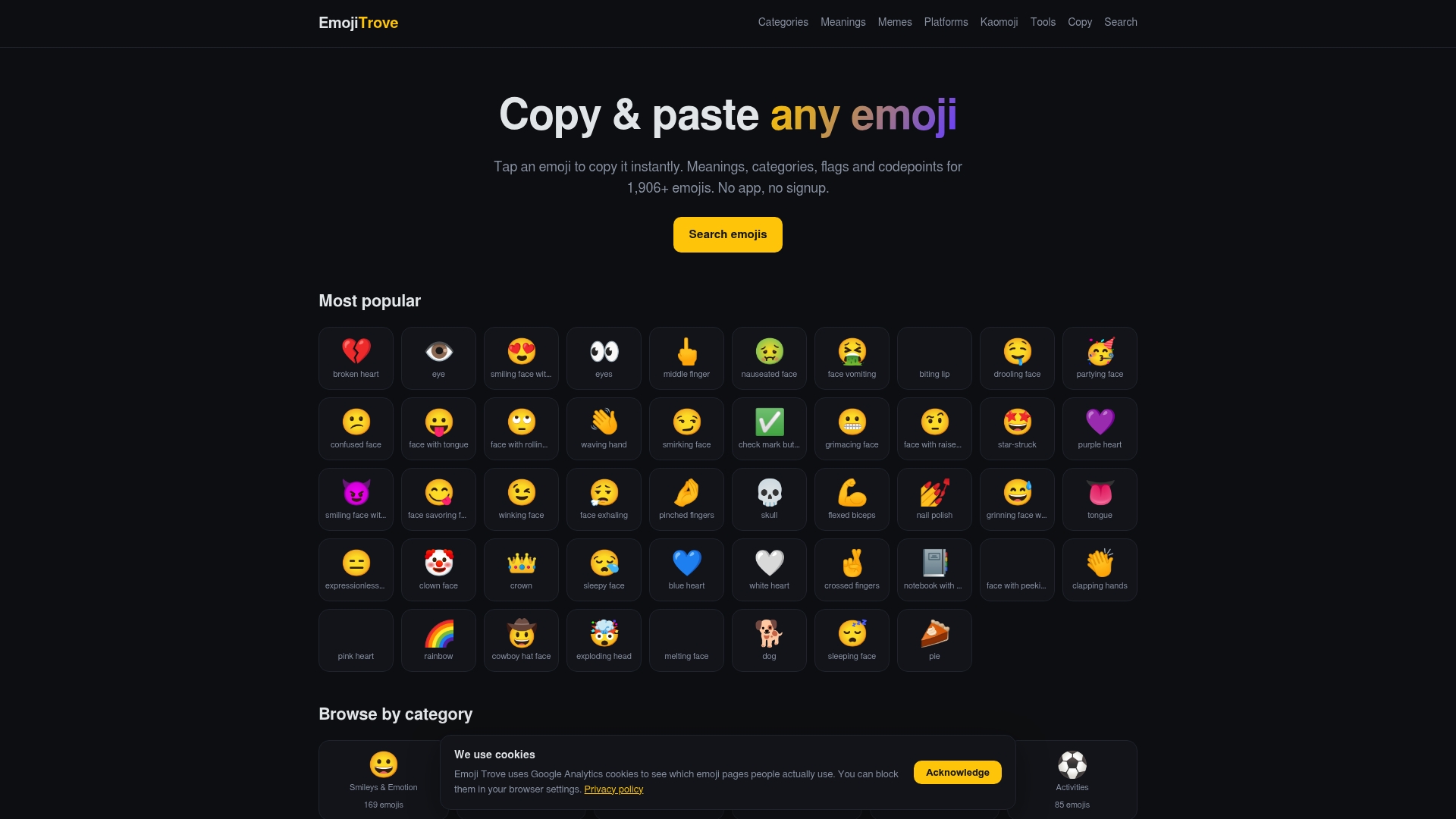
Start with the emoji copy and paste page, or browse our emoji guides for more on tone, platforms and meanings.
Perspective
We see the same pattern every day in how people search: they rarely want more emoji, they want the right one, fast. A welcome is a small moment, and the symbol you pick sets the mood before the first word is read.
Our view is that a good welcome has three parts: a clear greeting symbol, a short human sentence and a choice that fits the room. 👋 does the first job almost anywhere. The words do the second. The third is where a searchable, well-organized library helps, because you can check a symbol’s meaning and see its neighbors in the same theme before you commit.
That is why we pair every emoji with its meaning and usage, and why we group symbols by theme rather than leaving you to scroll an endless grid. If you are welcoming a new teammate, a server full of strangers or a friend who just got home, a thirty-second look at the options usually beats a guess.
Nkosi
FAQ
What is the best emoji to say welcome?
The waving hand 👋 is the most versatile choice, because it reads as a friendly hello in almost any setting. Use 🤗 for extra warmth, 🎉 for a celebration and 🤝 for a professional welcome. Add a few words so the meaning is never in doubt.
What emoji means “welcome home”?
There is no single official one. People combine 🏠 with 🤗 or ❤️ to say “welcome home,” and sometimes add 🎉 or 🥳 for a bigger celebration. Keep it to two or three symbols so the feeling comes through.
What emoji can I use to reply “you’re welcome”?
A smiling face like 😊 is a safe pick, and 👍 is widely understood as “okay” or “yes.” For a warmer reply, try 🤗. Avoid 🙏 with audiences you do not know well, since its meaning varies by culture.
Why does my welcome emoji look different on my friend’s phone?
Unicode defines the character, but each company draws its own version of it. A 🤗 on one device can look noticeably different on another. Older devices may also show a blank box for very new emoji, so choose long-established ones for important messages.
How many emojis should I use in a welcome message?
One to three is a good range for most social and chat settings, and no more than two on professional platforms like LinkedIn. In formal email, zero or one is usually right, placed at the end of a line.
Sources
- Emoji as interpersonal resources in LLM chatbot interactions (Taylor & Francis, 2025)
- Cross-Cultural Semiotics of Emoji Use (Redfame, 2026)
- Investigating the Potential for Miscommunication Using Emoji (GroupLens)
- The Problem With Emojis (Psychology Today)
- Emoji For Welcome (Otoy Studio)
- Emojis in customer service: why and how to use them? (Apizee)
- Customer Service Emojis (EngageBay)
- The Complete Guide to Email Emojis (Haiku)
- Emoji Marketing: How to Use Emojis for Your Brand (Michael Mackenzie)