Copy Love Emojis Fast: 10 Must Know Hearts, Faces, and Unicode Names
This is a complete, categorized love emojis list covering every heart color, affectionate face, and romantic symbol you’ll actually use in a text or caption, each with its official Unicode name and a real-world meaning attached. You’ll get a quick shortlist for when you’re in a hurry, plus a full catalog for when tone actually matters. Every emoji here can be copied directly through Emoji Trove’s tools, so you never have to hunt for a glyph twice.
TL;DR:
- The most common love emojis include hearts, face with hearts, kiss, and heart-eyes, which cover a range of affection from platonic to romantic.
- Colored hearts communicate different signals, with red for love, yellow for friendship, green for support, and purple or black often used within specific fandoms or to convey darker themes.
- Faces and gestures like smiling with hearts or heart hands specify the tone and intensity of affection, ranging from warmth to attraction or support.
- Repetition and platform rendering influence how emojis are perceived, so matching their use to relationship stage and checking how they appear on different devices is crucial.
- Emoji tools like Emoji Trove facilitate quick copying, ensure correct emoji choices, and help prevent miscommunication in romantic messaging.
Table of Contents
- Top 10 Love Emojis Everyone Should Know
- Complete Heart Emoji Catalog: Colors and Special Hearts
- Faces and Hand Gestures That Say “I Love You”
- Love-Themed Objects and Couple Symbols
- How to Choose and Combine Love Emojis Without Sending Mixed Signals
- Where the Names Come From: Unicode, Emojipedia, and Emoji Trove’s Tools
- An Editor’s Take on Overused and Underused Love Emojis
- Find and Copy Any Love Emoji in Seconds With Emoji Trove
- Sources
- FAQ
Top 10 Love Emojis Everyone Should Know
If you only remember ten emojis from this whole guide, make it these. They cover almost every romantic or affectionate situation you’ll run into on a normal day, and Unicode’s own frequency data confirms hearts and heart-faces sit near the top of everyday emoji use.
- ❤️ Red heart — the default “I love you” or “I love this,” works in almost any romantic or platonic context.
- 🥰 Smiling face with hearts — warm, genuine affection; softer than romantic, great for family and close friends too.
- 😘 Face blowing a kiss — flirty or affectionate goodbye, common between partners and close friends.
- 😍 Smiling face with heart-eyes — adoration or attraction, often for people, but also used for food, pets, or outfits.
- 💕 Two hearts — mutual affection, popular for couple posts and friendship shoutouts.
- 💖 Sparkling heart — excited, glowing affection, big in fandom and celebration posts.
- 💗 Growing heart — deepening feelings, often used early in a relationship.
- 💘 Heart with arrow — Cupid-coded, flirtation, crushes, and Valentine’s Day content.
- 🫶 Heart hands — platonic or romantic appreciation, huge on TikTok and Instagram captions.
- 💍 Ring — engagement, marriage, or “this is serious” romantic milestones.
Note that a few of these (🥰, 🫶) lean platonic as often as romantic. Context and who you’re texting still matter more than the glyph itself. Every one of these is copy-ready through Emoji Trove’s emoji tools.
Complete Heart Emoji Catalog: Colors and Special Hearts
Color is not decoration here. It’s the actual signal. Emojipedia’s breakdown of heart usage notes that while red stays dominant across every platform, colored and elaborated hearts carry their own micro-meanings shaped by fandom culture, aesthetic trends, and platonic signaling.
Colored hearts:
- ❤️ Red heart (CLDR: “red heart”) — classic love, the emoji equivalent of saying “love.”
- 🧡 Orange heart — warmth, friendship, and increasingly, support signals in fan communities. See the full orange heart meaning for context-specific uses.
- 💛 Yellow heart — happiness and platonic closeness; historically tied to “just friends” on apps like Snapchat.
- 💚 Green heart — nature, envy jokes, or support for certain causes and fandoms.
- 💙 Blue heart — calm, loyal affection, also a common “just supportive” signal.
- 💜 Purple heart — often romantic in casual use, but also carries military honor connotations in the U.S., so context matters.
- 🖤 Black heart — dark humor, edgy aesthetics, sometimes grief; rarely straightforwardly romantic.
- 🤍 White heart — purity, minimalism, sometimes grief or quiet devotion.
- 🤎 Brown heart — used for representation and inclusivity in skin-tone conversations, not typically romantic.
Special and animated hearts:
- 💗 Growing heart (“growing heart,” CLDR) — expanding affection, nervous excitement.
- 💓 Beating heart — anticipation, nervous love, a racing heart.
- 💖 Sparkling heart — celebratory, glowing affection.
- 💘 Heart with arrow — Cupid’s arrow, crush energy, Valentine’s content.
- 💝 Heart with ribbon — gifted love, a wrapped present of affection. See heart with ribbon for more usage notes.
- ❣️ Heart exclamation — urgent, emphatic affection, often used to punctuate a sentence rather than replace it.
- 💔 Broken heart — heartbreak, grief, or dramatic exaggeration of disappointment.
- ❦ /💕 Two hearts — mutual, reciprocal affection.
- ♥️ Heart suit — retro, minimal, often used stylistically rather than emotionally.
Pro Tip: Purple and black hearts render noticeably differently across Android, iOS, and older messaging apps. Check the Full Emoji List for the current vendor images before using an unusual heart color in something important, like a work message that autocompletes an emoji you didn’t intend.
One heart-color habit is genuinely underused: purple and black hearts function as coded signals inside specific fandoms and subcultures rather than universal romantic markers, so it’s worth testing a color with a small group before rolling it out broadly, the same way Emojipedia’s research on heart symbolism recommends.
Faces and Hand Gestures That Say “I Love You”
Hearts tell people you feel something. Faces and gestures tell them how much and what kind. The distinctions here are subtle but they change the entire tone of a message.
- 🥰 Smiling face with hearts — the Unicode CLDR entry defines this as warm, genuine affection (U+1F970). Use it for someone who did something sweet, not necessarily someone you’re attracted to.
- 😍 Smiling face with heart-eyes — this is adoration or attraction, defined at U+1F60D in the Unicode charts, and it leans more intense than 🥰. Great for “you look amazing” or genuine crush energy.
- 😘 Face blowing a kiss — an affectionate send-off, common between partners or close friends signing off a message.
- 😗 / 😙 Kissing faces — gentler, more casual versions of a kiss emoji, often used mid-conversation rather than as a goodbye.
- 🤗 Hugging face — comfort, support, and platonic warmth more often than romance.
- 🫶 Heart hands — appreciation, both platonic and romantic, currently one of the most-used affection gestures on social platforms.
- 🤟 Love-you gesture (ILY hand sign) — derived from American Sign Language, this one can read as culturally specific outside the U.S., so it’s worth checking that your audience recognizes it before leaning on it heavily.
The gap between 🥰 and 😍 trips people up constantly. 🥰 says “you’re sweet and I appreciate you.” 😍 says “I’m attracted to you or this thing is gorgeous.” Sending 😍 to a coworker who brought donuts is fine. Sending it to a new date after one conversation might read as fast. Full definitions for both live on Emoji Trove’s pages for 🥰 smiling face with hearts and 😍 smiling face with heart-eyes.
Love-Themed Objects and Couple Symbols
Not every romantic message needs a face or a heart. Objects carry their own weight, especially for milestones and captions.
- 💌 Love letter — old-school romance, often used for anniversary or “thinking of you” messages. See the love letter page for copy and examples.
- 💘 Heart with arrow — flirtation, new crushes, Cupid energy for Valentine’s captions.
- 💝 Heart with ribbon — a gift of affection, ideal for anniversaries or birthdays with a romantic angle.
- 💍 Ring — engagement announcements, wedding content, “he asked” captions.
- 💑 / 💏 Couple emojis (couple with heart, kiss) — these have gender and skin-tone variant options in Unicode, so the specific glyph you choose can visually represent a same-sex or mixed-tone couple. Worth checking the variant renders correctly on your platform before posting.
- 💐 Bouquet — romantic gestures, apologies, first dates, anniversaries.
A proposal caption might read: “He asked. 💍💌” An anniversary post works well as “Six years down. 💝💑” Valentine’s Day content leans naturally on “💘💐 happy valentine’s.”
How to Choose and Combine Love Emojis Without Sending Mixed Signals
Getting the tone right comes down to matching intensity to context, not memorizing rules. A few practical guidelines make this almost automatic once you internalize them.
- Match intensity to the relationship stage. ❤️ or 🥰 for new relationships and friends; 💘💖 for established romance; save 💍 for actual milestones, not jokes (unless the joke is obvious).
- Don’t overload casual messages with intense hearts. Three red hearts on a “see you at 6” text reads differently than one does. Repetition amplifies emotional weight fast.
- Consider platform rendering before sending something important. An emoji that looks playful on iPhone can look flatter or more serious on Android or in an older app version, a point Unicode’s own emoji charts illustrate through their vendor comparison images.
- Combos carry meaning of their own. 😍🔥 usually signals attraction plus excitement. 🥰💕 reads as soft, mutual affection. 💔😭 is heartbreak plus visible emotion, more dramatic than 💔 alone.
- Choose emoji-only replies carefully. A single ❤️ in response to a long message can feel dismissive; pairing a short reply with an emoji (“that’s so sweet ❤️”) almost always lands better than the emoji by itself.
Pro Tip: Before sending an important message with an unusual emoji, paste it into a message to yourself first and check how it renders on your own phone. If you’re on iOS texting an Android user, colors and expressions can shift enough to change the entire meaning.
If you’re navigating group chats where tone gets read by multiple people at once, this group chat etiquette guide covers frequency and appropriateness in more detail.
Where the Names Come From: Unicode, Emojipedia, and Emoji Trove’s Tools
Every meaning in this guide traces back to Unicode’s CLDR (Common Locale Data Repository) short names, the language-neutral standard that defines what each emoji is officially called and how it’s categorized across platforms. The Full Emoji List is the canonical source, showing vendor-specific images so you can see exactly how a heart or face renders on different systems before you send it.
Emoji Trove translates that standard into something usable:
- A searchable library of over 1,900 emojis organized by theme, so you’re not scrolling through an entire keyboard to find one heart.
- Individual pages per emoji with meanings, examples, and one-click copy, including entries like 🥰 and 😍.
- Themed collections, similar to the site’s flag emoji set, that group related glyphs together instead of forcing you to search one at a time.
To copy any emoji on desktop, click the glyph and it copies to your clipboard automatically. On mobile, tap and hold to copy, then paste directly into your messaging app or caption field.
An Editor’s Take on Overused and Underused Love Emojis
Most people default to ❤️ and 😘 because they’re safe, and that’s exactly why they’ve lost some of their punch. The emoji doing quieter, better work right now is 🫶. It reads as warm without forcing a romantic label onto something that might just be gratitude or support, which makes it useful in exactly the situations where 😍 or 💘 would overstate things.
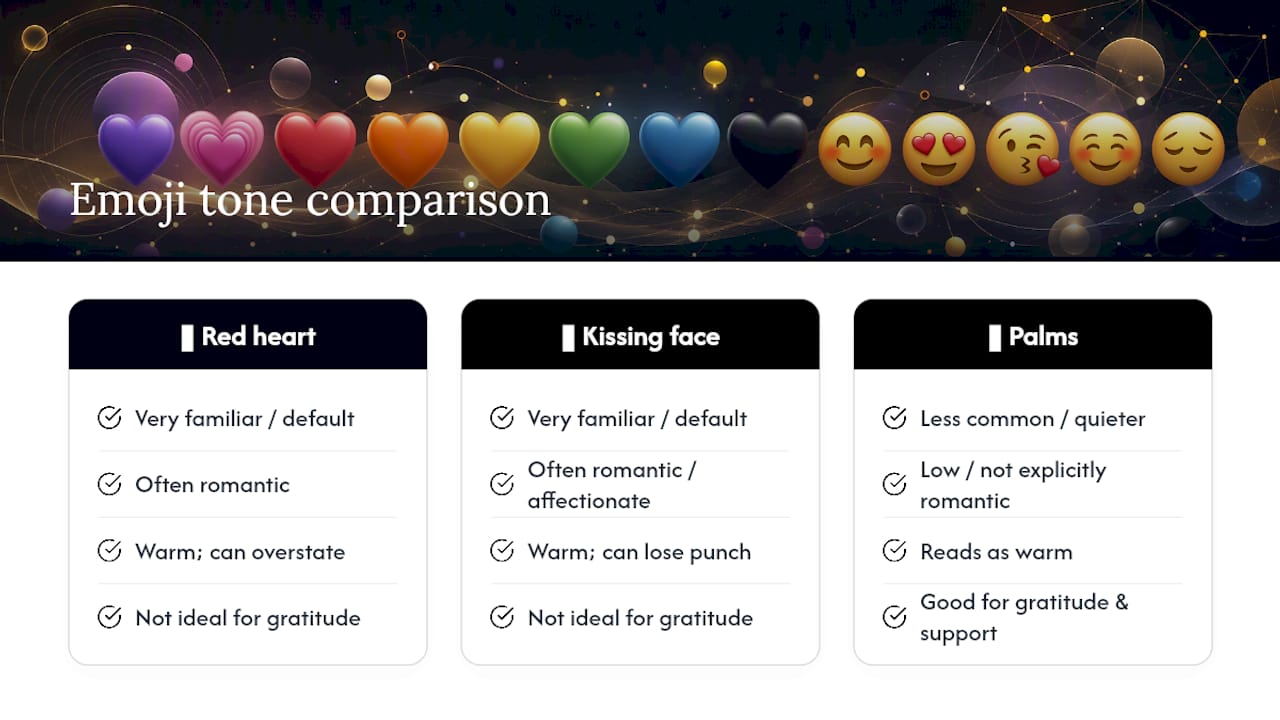
The mistake I see constantly is people treating hearts as interchangeable. They’re not. A purple heart and a red heart are not the same sentence with different colors; they’re different sentences. Sending 💜 to someone expecting ❤️ can read as oddly distant, even if you meant nothing by it.
My honest advice: pick two or three hearts you actually understand the tone of, and use those deliberately rather than grabbing whatever’s at the top of your recent emoji tray. Test unfamiliar ones in Emoji Trove’s emoji meanings reference before you use them somewhere it counts.
— Nkosi
Find and Copy Any Love Emoji in Seconds With Emoji Trove
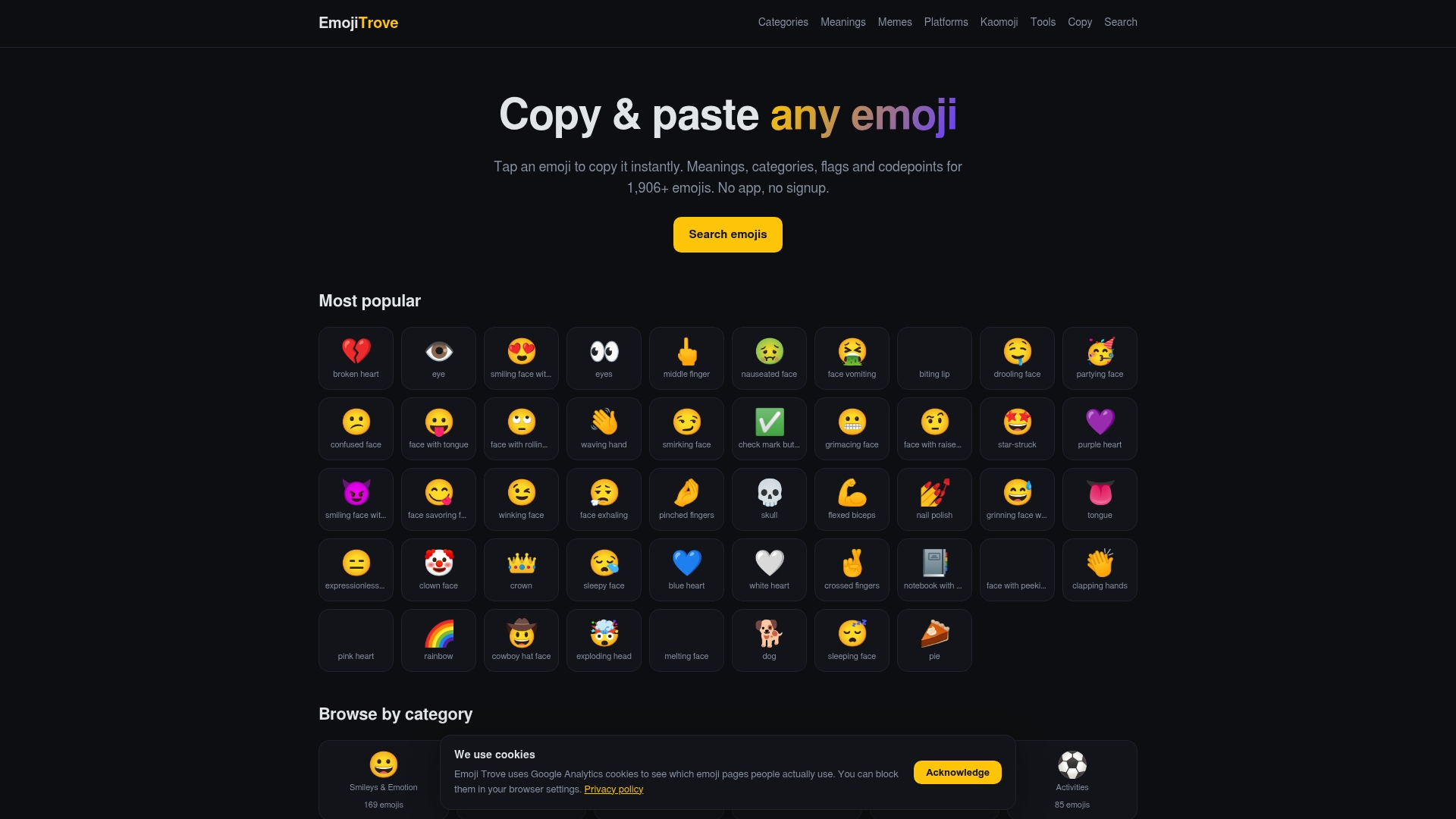
Scrolling through your phone’s default emoji keyboard to find the right shade of heart wastes time you don’t have mid-conversation. Emoji Trove’s searchable library puts every emoji in this list, plus over 1,900 more, one search away, with a copy button that skips the long-press guesswork entirely.
| Use case | Best emoji type | Where to go |
|---|---|---|
| Quick romantic reply | Hearts and heart-faces | Emoji copy and paste |
| Anniversary or proposal caption | Objects and symbols | Emoji meanings |
| Group chat or fandom post | Sparkling and colored hearts | Emoji tools |
Instead of memorizing every glyph in this guide, search by name or meaning directly in the emoji tools page and copy what fits your message in one click. If you want deeper meanings behind any entry before you send it, the emoji meanings hub breaks down usage and nuance for hundreds of emojis beyond just this list.
Sources
Meanings and names throughout this guide come from Unicode’s Full Emoji List, v17.0, the official registry for emoji names and codepoints, and from Emojipedia’s heart emoji breakdown, which tracks real-world usage patterns and platform trends. Both are widely regarded as the most reliable, actively maintained authorities in emoji documentation.
- Full Emoji List, v17.0
- Full Emoji List, v16.0
- What Every Heart Emoji Really Means
- Emoji frequency data (Unicode)
FAQ
What’s the difference between 🥰 and 😍?
🥰 (smiling face with hearts) signals warm, genuine affection and works for friends or partners; 😍 (smiling face with heart-eyes) signals stronger adoration or attraction and leans more romantic or intense.
What does 💦💦 mean from a guy?
The water droplets emoji typically signals sweat, exertion, or in flirtatious contexts, sexual attraction; it’s rarely a purely romantic or affectionate emoji and should be read carefully depending on the conversation.
What does it mean when a guy sends 💛💙💜💚❤️ in a row?
Sending a string of different colored hearts usually signals broad affection or excitement rather than one specific romantic message; check the individual heart meanings since colors like yellow and blue can lean platonic while red and purple often lean romantic.
What is the most powerful love emoji?
❤️ (red heart) remains the most universally recognized romantic emoji and tops most usage data, though 💍 (ring) and 💘 (heart with arrow) carry stronger, more specific romantic weight in milestone contexts.
How do I copy love emojis quickly for texts or captions?
Use a searchable emoji library like Emoji Trove’s copy and paste tool, where clicking or tapping any emoji copies it instantly without scrolling through a phone keyboard.