Marketing Emojis: What to Use, Where and Why

The best marketing emojis are the ones that match your message and your audience: 📣 for announcements, 📈 for growth, 🎯 for goals, 💡 for ideas, 🛍️ for shopping. Use one to three per message, put them where they support the words rather than replace them, and check how they look on different devices. The rest of this guide covers which symbols say what, how to choose for your brand, and what the evidence shows about engagement.
TL;DR
- Pick emojis with a clear, literal link to your message: 📣 announcements, 📈 growth, 🎯 goals, 🛒 shopping, 📧 email.
- Keep it to roughly one to three per message, and keep the text understandable without them.
- Results are mixed: some large datasets show lifts, but email tests show emojis amplify a good subject line rather than rescue a weak one.
- Preview on iOS and Android, and skip emojis in serious or crisis messages.
- Build a short approved list for your team, then test emoji against no-emoji versions.
Table of Contents
- Which emojis stand for marketing
- Choose emojis that fit your brand voice
- How many emojis, and where, by platform
- Emojis in email subject lines
- What the evidence says about engagement
- Examples of emoji marketing in practice
- Accessibility, rendering and culture
- When to skip emojis
- Perspective
- Find and copy marketing emojis fast
- A simple workflow for your next campaign
- FAQ
- Sources
Which emojis stand for marketing
There is no single official marketing emoji. Marketers borrow symbols from business, communication and shopping, and the meaning comes from convention. The groups below are the ones that show up most in brand guides.
| Idea you want to signal | Emojis | Typical reading |
|---|---|---|
| Announcement, news, reminder | 📣 | A megaphone signals announcements, reminders or news; ✨ suggests highlights or launches |
| Growth, results | 📈 🚀 | Increase or improvement |
| Data and reporting | 📊 | Data, reports and statistics |
| Goals, targeting | 🎯 | Goals or objectives |
| Ideas, creativity | 💡 | Idea generation and innovation |
| Partnerships, deals | 🤝 | Deals, partnerships or agreements |
| Shopping, e-commerce | 🛒 🛍️ | Product selling or shopping |
| Payments, revenue | 💳 💵 💰 | Transactions and money topics |
| Shipping, products | 📦 | Shipping, products or deliveries |
| 📧 | Communication via email or announcements | |
| Done, key points | ✅ | Checklists and completed items |
For warmth and emotion, the usual picks are ❤️ for affection or appreciation, 👍 for approval, 😊 for joy, 🔥 for something popular or intense, and 🙏 for thanks or hope. Emojis such as 👉 and 👇 can playfully say “click here”, which is why HubSpot lists pointing fingers among the most popular across platforms.
Combos that work as a set
Single emojis are clear. Pairs and short strings can tell a tiny story, but only if each symbol has a job:
- 📣🎯 for a campaign announcement with a clear target
- 💡📈 for an idea and its results
- 🛍️✨ for a new product drop
- 📧✅ for a confirmation or “you’re signed up” note
- 🤝🚀 for a partnership launch
If you cannot say what each emoji contributes, drop it. A string of five symbols reads as decoration.
Choose emojis that fit your brand voice
Start with who you sound like. A playful snack brand and a payroll software company should not use the same emoji set, even for the same idea.
The practical advice repeated across brand guides comes down to a few habits:
- Match the brand personality. MoEngage advises choosing emojis relevant to your personality, researching their meanings, previewing them on different devices and adjusting type and quantity to the channel and tone.
- Write an approved list. Brandwatch recommends a short list of approved emojis tied to brand tone, shared with the team. Five to ten symbols is plenty.
- Reinforce, don’t decorate. The same guide says emojis should support the message instead of adding random flourish, with roughly one to three per message depending on length and context.
- Check authenticity. Fanpage Karma suggests asking whether your community already uses the symbol, whether its ironic meaning is understood, and whether the post still works without it.
That last test is the most useful single filter. If the post collapses without the emoji, the words are doing too little.
Watch for double meanings
Some symbols carry more than one reading. The Digital Marketing Institute notes that 💀 can signal uncontrollable laughter, 👍 can come across as aloof, annoyed or sarcastic, and 🔥 can mean hot or on fire. Before a symbol goes into a campaign, look up its meaning and common uses. A reference library with meanings and Unicode data, like the one we run at Emoji Trove, saves you from guessing.
How many emojis, and where, by platform
Density depends on the channel. The Digital Marketing Institute’s view is that playful visual platforms tolerate more, while professional channels benefit from one or two deliberate cues. Michael Mackenzie Communications describes Instagram as more emoji-friendly, Facebook as suitable for community and event content, and LinkedIn as a place for light, intentional use.
A workable starting point:
| Channel | Density | Where to place them |
|---|---|---|
| Instagram, TikTok captions | Moderate, playful | End of lines, as tone markers |
| Facebook posts | Light to moderate | Event and community posts, one or two |
| X (Twitter) | Light | One to close a short post |
| One or two | A single visual cue, never a string | |
| Email subject lines | One at most | Start or end, after you test |
| Push notifications | One | Next to a short, clear message |
These are starting points to adjust with your own results, not rules. If you want practical help balancing emojis with clear copy across Meta platforms, this social media marketing guidance covers tone and message fit for Facebook and Instagram.
Emojis in email subject lines
Email is where the data is most useful, because the tests are large and the results are honest about their limits.
- Search Engine Journal measured 3,893,391 emails across 17 campaigns. Non-emoji subject lines won on open rate in 52.94% of campaigns, while emoji versions had higher click-through rates in 64.71%. Measure clicks, not just opens.
- Phrasee analyzed 2 million English-language subject lines and found that 5% contained an emoji, and 100 emojis made up 66% of use. In a controlled test with more than 470,000 subscribers, emoji lines beat the plain version in 60% of tests, but the result was not conclusive as an always-use rule.
- Reply.io reported a 30.91% average open rate overall and 37.8% for emoji subject lines across more than 2 million emails. Averages like this mix different senders and audiences, so treat them as a hint.
The pattern: an emoji amplifies a subject line that is already good. It does not fix a vague one.
For casual promotional emails, Zoho recommends carefully selected emojis, and a single relevant emoji may suit a subject line. The same guide advises avoiding them in formal communications, legal disclaimers, important information, and international campaigns with real interpretation risk. MoEngage also recommends A/B testing emoji and non-emoji variants in email and push.
A simple email test
- Write one subject line that stands on its own.
- Make a second version with one emoji from your approved list.
- Split your list evenly and send both.
- Compare clicks and conversions, not only opens.
- Repeat on a different campaign before you change your rule.
What the evidence says about engagement
The headline numbers are tempting, so read them carefully.
HubSpot reported that emojis in tweets can increase engagement by 25.4%, and emojis in Facebook posts can increase likes by 57% and comments and shares by 33%, based on 19,617,281 of its own posts across five social platforms. That is a large sample, but it comes from one publisher’s content, so use it as a reason to test rather than a promise.

Academic work points the same way with a local caveat. A 2025 study in the Journal of Audiovisual Translation with 171 Polish participants found a preference for TikTok subtitles with emojis and non-standard typography, and higher likes, shares and comments for videos in that style. It is a Poland-specific result, so test it with your own audience before applying it elsewhere.
The takeaway for a marketer: emojis can help engagement on social posts, the effect depends on audience and context, and your own A/B results beat any industry average.
Examples of emoji marketing in practice
Brand stories show what the symbols can do when the idea is strong.
- Samsung Galaxy S8. Edelman’s team answered a hostile tweet with a microscope emoji. The case study reports 72,483 retweets, 228,000 likes and more than 80 news stories. The win came from quick, context-aware community management, not from the emoji alone.
- Domino’s, Burger King and Coca-Cola. A roundup describes Domino’s pizza ordering by 🍕 tweet, Burger King emoji artwork with QR codes leading to app coupons, and Coca-Cola emojis on Latin American packaging.
- WWF #EndangeredEmoji. Smart Insights describes a campaign where retweeting endangered-animal emojis encouraged donations.
Notice what these share: the emoji was the center of a clear idea, with a reaction, an action or a story attached. Sprinkling 🔥 on a discount post is not the same thing.
Accessibility, rendering and culture
This is the part many teams skip, and it is where emojis go wrong quietly.
Microsoft’s style guide notes that emojis have literal CLDR or Unicode names that screen readers may announce. Its recommendations are practical:
- Do not use emojis to replace words.
- Avoid them in serious topics.
- Place them at the end of a sentence or post.
- Limit use to about three per message.
- Avoid emoji bullets.
- Check device rendering and cultural implications.
That last point matters because the same code point looks different across platforms. Preview your final copy on both iOS and Android, as MoEngage recommends. A screen reader reading “rocket, chart increasing, bullseye” in the middle of your sentence is a poor experience, so put the symbols at the end.
For a global audience, remember that a gesture or object can read differently by country. When a symbol’s meaning is unclear, pick another.
When to skip emojis
Leaving them out is part of good emoji marketing. Skip them when:
- The message is a crisis statement or other serious announcement. Brandwatch advises avoiding emojis when a playful symbol could undermine the message.
- The slang or intended meaning is unclear, or the emoji would replace words, or it may display differently across devices, per Michael Mackenzie Communications.
- The email is formal, legal, or carries important information, per the Zoho guidance above.
Perspective
Most emoji advice fails at the same step: finding the right symbol takes longer than writing the post. People scroll, guess, paste something that looks right, and only later find it means something else.
We built Emoji Trove to shorten that step. Our library holds over 1,900 emojis sorted by theme, with search, meanings and uses, and Unicode data, so you can check what a symbol says before it goes out under your brand name.
For marketers, we think the habit that pays off is simple: choose a small set, know what each one means, copy it in one click, and keep it consistent. Themed and bulk sets help you build that approved list in minutes instead of days.
The tools and guides around the library, from text generators to platform-specific instructions, are there for the same reason: your words stay in charge, and the emoji does one clear job.
Nkosi
Find and copy marketing emojis fast
If you are building an approved list or drafting a post, browse the Emoji Trove emoji library. You can search by keyword, explore themed categories, read what each emoji means, and copy it to your clipboard instantly.
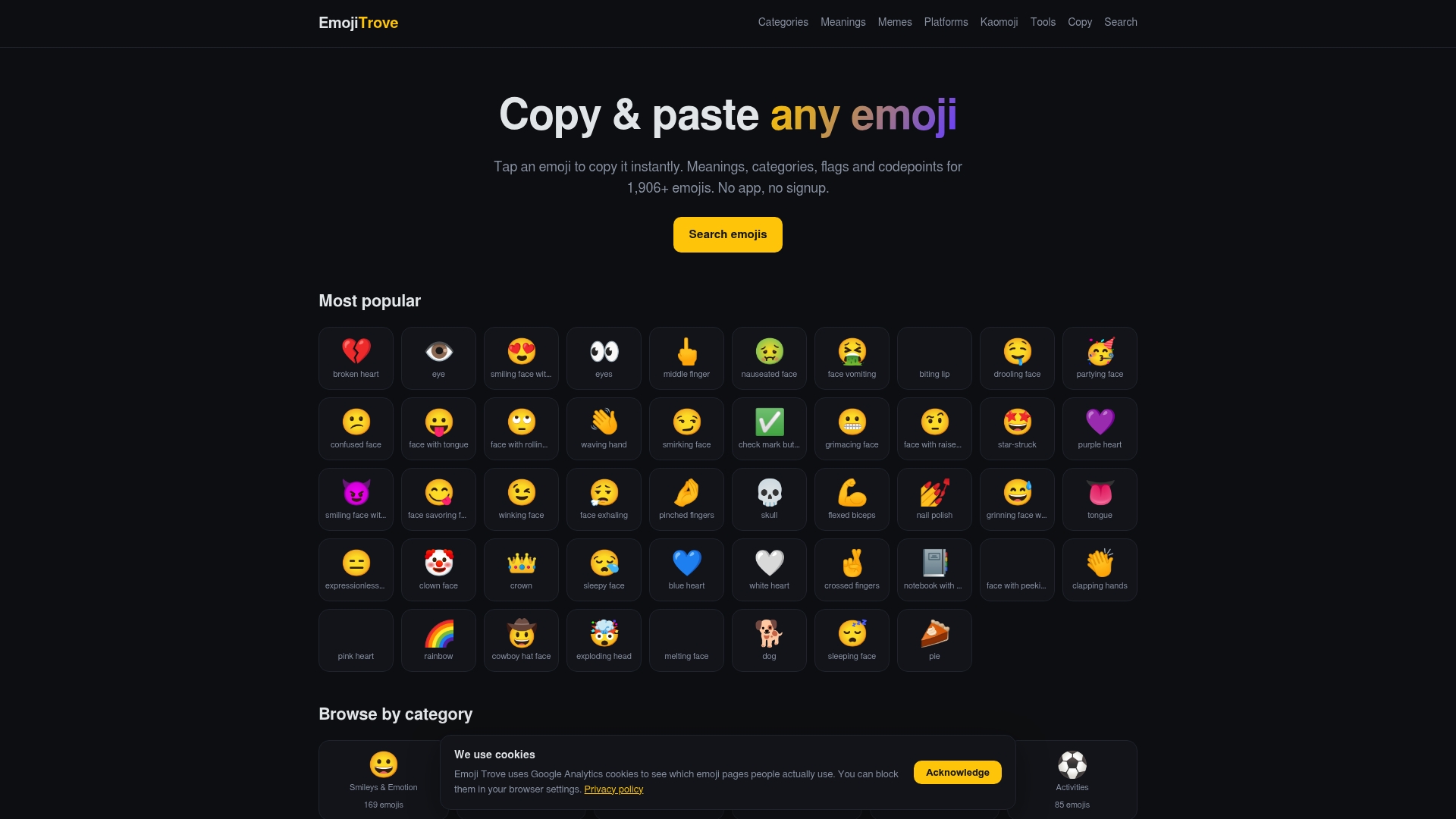
The library also includes Unicode data for developers, themed and bulk sets for campaigns, and instructions for specific platforms, so one visit covers the lookup, the meaning check and the copy.
A simple workflow for your next campaign
- Define the message. Write it in plain words first.
- Choose one to three emojis. Pick symbols with a literal link, such as 📣 for news or 🛒 for a sale.
- Check meanings. Look up each symbol for secondary or ironic readings.
- Place them well. Put them at the end of the sentence or post, never as bullets.
- Preview. Check iOS and Android, and read the copy as a screen reader would.
- Test. Run emoji against no-emoji versions and judge clicks and conversions.
- Record the winners. Add what works to your team’s approved list.
FAQ
What is a good emoji for marketing?
📣 is the most common choice because it signals announcements, news and reminders. 📈 suits growth or results, 🎯 goals, and 💡 ideas. Choose the one whose literal meaning matches your message.
How many emojis should I use in a marketing post?
A common guideline is one to three per message, depending on length and channel. Microsoft’s style guidance also suggests about three at most. On professional channels such as LinkedIn, one or two deliberate cues is enough.
Do emojis increase engagement?
Sometimes. HubSpot’s analysis of its own posts reported higher engagement on social platforms, while large email tests show a mixed picture on opens and a better one on clicks. Because results vary by audience, run your own A/B test.
Are emojis safe in email subject lines?
For casual promotional emails, one relevant emoji is a reasonable thing to test. Avoid them in formal messages and important information, and compare clicks as well as opens before making it a rule.
Sources
- Business emojis: how, when, and where to use them
- Emoji Marketing: How to Use Emojis for Your Brand
- 150 Best Business Emojis To Make Your Content More Engaging
- Do Emojis Belong in Your Digital Marketing Strategy?
- These Emojis Can Increase Click-Through Rates
- How to Use Emoji Marketing to Drive Customer Engagement
- Mastering Emoji Marketing: Tips for Engaging Your Audience
- What You Need to Know about Using Social Media Emojis
- Gen Z Emojis in Social Media Marketing
- Using emojis in marketing for a global audience
- Emojis in Email Subject Lines: Do They Affect Open Rates?
- Emoji… or eNOji?
- Can Emojis and Attachments Impact Your Cold Email
- Beyond Traditional Subtitles: How Emojis and Non-Standard Typography
- Microsoft Style Guide: emoji, emoticons
- Samsung Galaxy S8 Microscope, Edelman
- The Art of Emoji Marketing: 10 Clever Examples
- How brands have used emoji marketing successfully
- Facebook and Instagram Social Media Marketing