Copy Medical Emojis Fast: 9 Essential Symbols to Paste

The medical emojis people actually reach for are 💉 (syringe), 💊 (pill), 🩹 (adhesive bandage), 🩺 (stethoscope), 🏥 (hospital), 🩻 (X-ray), 🩸 (drop of blood), 🩼 (crutch), and ⚕️ (the medical symbol). Each one carries a specific meaning and a specific job, whether you’re texting a friend before surgery or writing a caption for a health awareness campaign. What follows is a quick reference for what each symbol means, how to combine them into ready-made message snippets, and how to copy them cleanly across any platform.
TL;DR:
- Medical emojis like 💉, 💊, and 🩹 are best suited for casual updates, recovery posts, or public health campaigns, not detailed medical disclosures.
- The appearance of medical emojis varies across platforms, so copying directly from a reliable source ensures consistent rendering and understanding.
- Using emojis respectfully requires plain alt text and avoiding sensitive or serious conditions unless paired with clear, appropriate language.
- Emoji Trove offers a centralized library with over 1,900 emojis, making it quick to find and copy the exact medical icon for any message.
- Pairing one or two medical emojis with simple, straightforward language improves clarity while maintaining a friendly tone.
Table of Contents
- What Do the Main Medical Emojis Mean?
- How Should You Use Medical Emojis in Messages?
- Why Do Medical Emojis Look Different on Every Platform?
- How Do You Use Medical Emojis Respectfully?
- Ready-to-Use Medical Emoji Message Templates
- Why Emoji Trove Makes Finding Medical Emojis Faster
- Copy Medical Emojis Instantly With Emoji Trove
- Sources
- FAQ
What Do the Main Medical Emojis Mean?
Each medical emoji has an official Unicode name and a plain-language meaning that’s often broader than the literal image suggests. Here’s the core set, with the emoji, its formal name, what it actually communicates, and a quick example of when people use it.
- 💉 Syringe — Unicode name “Syringe.” Represents injections, vaccinations, blood draws, or medical treatment generally. Example: “Flu shot done ✅💉”
- 💊 Pill — Unicode name “Pill.” Signals medication, prescriptions, or dosing reminders. Example: “Time for your 8pm dose 💊”
- 🩹 Adhesive Bandage — Also called the “Band-Aid” emoji. Covers minor injuries, healing, or light-hearted “I’ll survive” messages. Example: “Scraped my knee but I’m fine 🩹”
- 🩺 Stethoscope — Represents checkups, diagnosis, and the act of seeing a doctor. Example: “Annual physical today 🩺”
- 🏥 Hospital — A building with a red cross, meaning a hospital, clinic, or medical facility. Its official CLDR label and Unicode name is simply “Hospital,” which is what search engines and screen readers key off when someone types “hospital emoji” into a picker, according to Codepoints’ entry for U+1F3E5. Example: “At the hospital with Mom, will update soon 🏥”
- 🩻 X-ray — A newer emoji showing a skeletal scan image, used for imaging, fractures, or diagnostic tests. Example: “Got my X-ray results back 🩻”
- 🩸 Drop of Blood — Represents blood donation, blood tests, or menstruation depending on context. Example: “Donating blood this afternoon 🩸”
- 🩼 Crutch — Denotes injury recovery, mobility aids, or being temporarily laid up. Example: “On crutches for the next six weeks 🩼”
- ⚕️ Medical Symbol — Also called the Staff of Aesculapius, this is the formal medicine and healthcare symbol used on signage worldwide. It’s frequently confused with the two-snake caduceus, a related but historically distinct symbol more common in American commercial medical branding, according to Wikipedia’s history of the caduceus. Example: “New clinic opening ⚕️”
You’ll also see the mortar and pestle used as a pharmacy shorthand in some emoji sets, a nod to the tool’s long association with compounding medicine, as Wikipedia notes in its history of the mortar and pestle. It’s less universal than the other nine, but worth knowing if you’re writing pharmacy-related content.
How Should You Use Medical Emojis in Messages?
Medical emojis work differently depending on the situation. A syringe emoji in a group chat with friends reads casually; the same emoji in a hospital’s social post reads informational. Match the emoji to the context, not just the topic.
- Appointment updates. Use 🩺 or 🏥 to flag you’re at a checkup or facility, without oversharing details.
- Availability or status. 🩹 or 🩼 signal you’re recovering and might be slower to respond, a pattern researcher at Harvard Medical School point to as one of the most common real-world uses of health emojis: quick status signaling rather than literal description.
- Supporting someone else. Pair 🩹 or 💊 with warm, simple language: “Thinking of you, hope you feel better soon 🩹” reads better than a string of emojis alone.
- Public-health posts. 🩺 and 💉 fit vaccination reminders or checkup campaigns; keep the tone neutral and factual.
- Donation or awareness asks. 🩸 works well for blood drives; pairing it with a clear call to action outperforms the emoji standing alone.
Pro Tip: Dial back emoji use with clinical or older audiences, and skip anything cutesy (like a smiling bandage) in professional health communications; save the playful combos for close friends and casual social posts.
Why Do Medical Emojis Look Different on Every Platform?
Apple, Google, Samsung, and X (formerly Twitter) each design their own emoji artwork, so 🩻 or 🩺 can look noticeably different depending on where you view it, even though the underlying character is identical. A stethoscope might look sleek and monochrome on one platform and rounded and colorful on another.
To copy any emoji reliably, click or tap it directly from a source that displays the character itself (not just an image), then paste it into your message. If an emoji occasionally renders as plain black-and-white text instead of full color, that’s a variation selector issue. Adding Variation Selector-16 (U+FE0F) after the base codepoint forces emoji-style rendering; Variation Selector-15 forces text-style. The hospital emoji’s base codepoint is U+1F3E5, and checking a reference like Codepoints or Emoji will confirm the exact styling and suggested use cases before you post.
| Emoji | Unicode Name | Codepoint | Where to Verify |
|---|---|---|---|
| 🏥 Hospital | HOSPITAL | U+1F3E5 | Codepoints |
| 💉 Syringe | SYRINGE | U+1F489 | Unicode emoji charts |
| 🩺 Stethoscope | STETHOSCOPE | U+1FA7A | Unicode emoji charts |
| 🩸 Drop of Blood | DROP OF BLOOD | U+1FA78 | Unicode emoji charts |
For a broader look at how the same character shifts across apps, Emoji Trove’s platform rendering guide breaks down the visual differences you’ll run into most.
How Do You Use Medical Emojis Respectfully?
Health topics carry weight, so a few ground rules keep your messages clear and kind rather than careless.
- Write alt text in plain, literal terms: “hospital building icon” or “syringe icon” works better for screen readers than a vague description.
- Never share specific diagnoses, test results, or private medical details in a public caption, even alongside a fitting emoji.
- Avoid pairing serious conditions (cancer, chronic illness) with lighthearted emoji strings, which can read as dismissive.
- Don’t use 💊 or 🩺 to imply medical advice; emojis are a tone signal, not a diagnosis or treatment recommendation.
- When posting about blood donation or lab work, a nod to proper terminology helps; Nursing School Pro’s breakdown of blood draw procedures is a useful reference if you want your captions to sound accurate rather than guess.
Ready-to-Use Medical Emoji Message Templates
- “Quick update: at my appointment now, will text when I’m out 🩺”
- “Home from the hospital, resting up 🏥🩹”
- “Blood drive this Saturday, come roll up your sleeve 🩸”
- “Flu shots available all week 💉📅”
- “Broke my ankle, crutches for a month 🩼”
- “X-ray came back clear, relief 🩻✅”
- “Refill reminder: pick up your meds today 💊”
- “New wing opening at the clinic ⚕️🏥”
Casual chats can stack two or three emojis; formal posts read cleaner with just one paired against clear text.
Why Emoji Trove Makes Finding Medical Emojis Faster
Scrolling through a phone’s default emoji keyboard to find the right medical icon wastes time you don’t have when you’re mid-conversation. Emoji Trove’s library organizes over 1,900 emojis by category, so medical symbols sit together instead of scattered across a generic grid. Each entry links to a full meaning page with context and usage notes, which helps when you’re unsure whether 🩹 or 🩺 fits your message better. It’s a small tool built around a common frustration: finding the right icon shouldn’t take longer than writing the message itself.
— Nkosi
Copy Medical Emojis Instantly With Emoji Trove
Digging through a phone keyboard or scrolling a crowded picker to find one specific medical icon gets old fast, especially when you’re writing something time-sensitive like an appointment update. Emoji Trove’s copy and paste tool puts every emoji from this list, syringe, stethoscope, hospital, X-ray, crutch, and the rest, in one searchable place, so you click once and paste directly into your message or post.
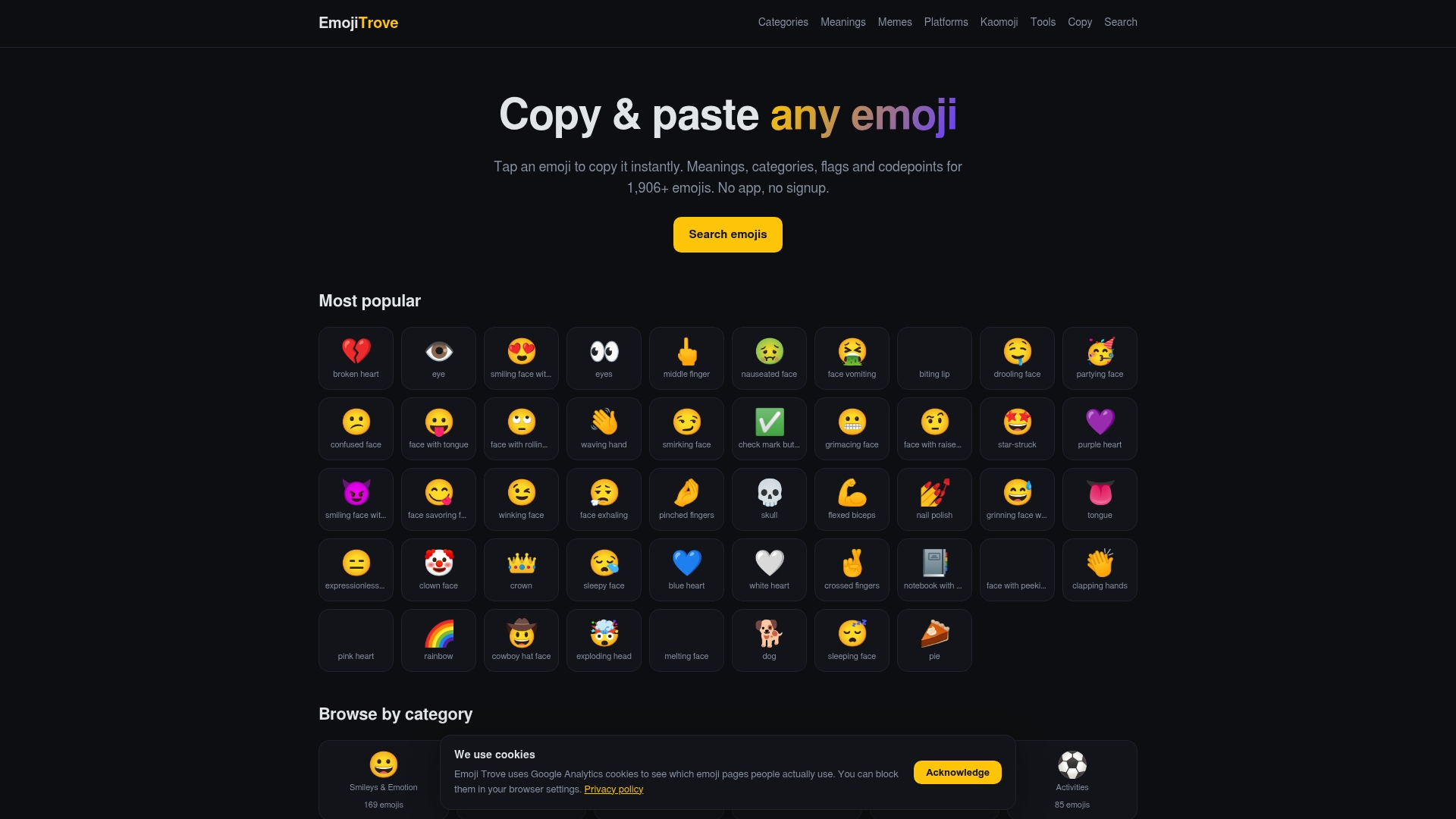
Beyond copying, the site’s broader emoji tools collection covers text generators and translators if you’re building out longer health-related content, and the meaning pages go deeper on symbolism if you want to get the tone exactly right before you hit send. Head to the copy page, search “medical,” and grab what you need in seconds.
Sources
- Emoji power (Harvard Medical School)
- U+1F3E5 HOSPITAL: 🏥 – Codepoints
- Emoji
- Caduceus as a symbol of medicine — Wikipedia
FAQ
What Is the Most Commonly Used Medical Emoji?
💉 (syringe) and 🩺 (stethoscope) rank among the most frequently used medical emojis, largely because they cover broad situations like vaccinations, treatment, and checkups.
Is There an Official Medical Symbol Emoji?
Yes, ⚕️ is the official medical symbol, based on the Staff of Aesculapius rather than the two-snake caduceus often seen on U.S. medical branding.
Why Does the Hospital Emoji Look Different on My Phone Versus a Friend’s?
Each platform, Apple, Google, and Samsung included, designs its own emoji artwork for the same Unicode character, so 🏥 can appear stylistically different while representing the identical codepoint, U+1F3E5.
Can I Use Medical Emojis to Announce a Diagnosis or Serious Illness?
You can, but pair them with clear, direct language rather than relying on the emoji alone, and avoid combinations that could read as flippant about a serious condition.
Where Can I Quickly Copy Medical Emojis for Messages?
Emoji Trove’s copy and paste page lets you search, preview, and copy medical emojis like 🩹, 🏥, and 💊 directly without hunting through your device’s default keyboard.