Scan 40+ Hand Emojis: Quick Meanings and One Click Copy
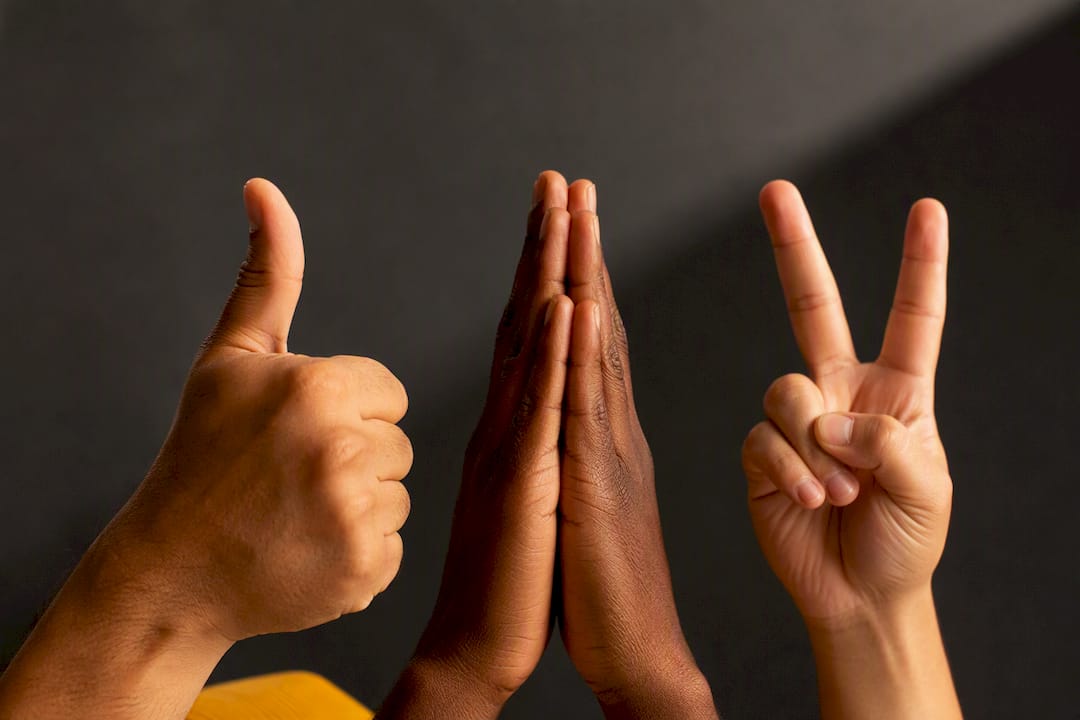
This is the master hand emojis list you can scan in seconds: every common gesture, its official name, a short meaning, and one example so you know exactly how to use it. You’ll also find skin-tone tips, platform quirks, and a few gestures worth using carefully. Unicode sets the official names, and Copy tools let you grab the right symbol without hunting through your keyboard’s emoji panel.
TL;DR:
- Over 40 hand emojis are categorized into pointing, gestures, fists, and expressive types, with new gestures added periodically by Unicode.
- Skin-tone modifiers are supported by most emojis, but appearance may vary significantly across different platforms and devices.
- Certain gestures like the OK hand or thumbs up carry cultural or contextual baggage, requiring careful consideration before use in professional or cross-cultural communication.
- Previewing how emojis render on different devices before sending helps prevent misinterpretation, as glyph appearance can change tone dramatically.
- Using copy and paste tools streamlines selecting, previewing, and accurately inserting hand emojis into messages to avoid confusion or unintended signals.
Table of Contents
- The Full Hand Emojis List by Category
- How to Use Hand Emojis: Skin Tones, Sequences, and Copy Tips
- Context and Cautions: Gestures Worth a Second Thought
- Why Emoji Trove Is Built for Fast Hand Emoji Lookups
- What Actually Matters When You’re Picking a Hand Emoji
- Copy, Preview, and Send the Right Gesture in Seconds
- Where This List Comes From
- Sources
- FAQ
The Full Hand Emojis List by Category
Unicode currently groups over 40 hand-related symbols under its “Hands” category, with new gestures added periodically. Scrolling through a phone keyboard to find the right one wastes time, so here’s the full breakdown grouped the way people actually search for them: pointing and fingers, single-hand gestures, two-hand gestures, fists, and expressive or fashion-forward gestures.
Pointing and finger gestures
- ☝️ Index Pointing Up — Emphasis or “one moment.” Example: “☝️ before you go, check this.”
- 👆 Backhand Index Pointing Up — Directs attention upward or to something above. Example: “See the note ☝️? Read that first.”
- 👇 Backhand Index Pointing Down — Points to something below, often used before a link. Example: “Full details 👇”
- 👈 Backhand Index Pointing Left — Points left, often paired with 👉 for a shy or “come here” vibe. Example: “That one 👈”
- 👉 Backhand Index Pointing Right — Points right, frequently used in the popular “👉👈” shy gesture. Example: “Me when I like someone 👉👈”
- 🫵 Index Pointing at the Viewer — Directly calls out the reader, a newer Unicode addition. Example: “Yes, 🫵, you can do this.”
- 🖕 Middle Finger — A vulgar insult; best avoided in most digital communication, especially professional or cross-cultural contexts.
Single-hand gestures
- 👋 Waving Hand — Hello or goodbye. Example: “👋 see you tomorrow!”
- 🤚 Raised Back of Hand — Similar to a stop gesture, shown from the back. Example: “🤚 that’s enough for today.”
- 🖐️ Hand with Fingers Splayed — A high-five or “stop” gesture with all five fingers spread. Example: “🖐️ high five for finishing that project.”
- ✋ Raised Hand — Signals “stop,” “wait,” or a request to speak. This gesture has quietly become the standard way to ask for the floor in virtual meetings, replacing the old habit of unmuting to interrupt.
- 👍 Thumbs Up — Approval or agreement. Example: “Sounds good 👍”
- 👎 Thumbs Down — Disapproval or disagreement. Example: “That plan? 👎”
- ✊ Raised Fist — Solidarity or resistance. Example: “Standing with you ✊”
- 👊 Oncoming Fist — A fist bump greeting. Example: “Nailed the interview 👊”
- 🤛 Left-Facing Fist and 🤜 Right-Facing Fist — Halves of a fist bump, often used together across a text thread.
- ✍️ Writing Hand — Signing, note-taking, or “I’m working on it.” Example: “✍️ drafting the reply now.”
- 💅 Nail Polish — Confidence, indifference, or “not my problem.” Example: “Handled it and moved on 💅”
- 🤳 Selfie — Taking a photo of yourself. Example: “Beach day 🤳”
- 🤏 Pinching Hand — Indicates something small or exact. Example: “Just a 🤏 bit more salt.”
- 🤌 Pinched Fingers — Known as the “Italian hand,” this reads as emphasis, exasperation, or “what do you mean?” depending on tone. WikiHow’s breakdown notes it’s grown well beyond its Italian gesture roots into general frustration or “come on, explain.”
- 🫰 Hand with Index Finger and Thumb Crossed — A finger-heart gesture popularized by K-pop culture, meaning affection or appreciation. Example: “🫰 love this song.”
- 🤟 Love-You Gesture — This one maps directly to American Sign Language’s “I love you” sign, combining the pinky, index, and thumb.
- 🤘 Sign of the Horns — Rock and roll, or “let’s go.” Example: “Concert tonight 🤘”
- 🤙 Call Me Hand — “Call me” or a laid-back, surfer-style greeting. Example: “🤙 hit me up later.”
- 🖖 Vulcan Salute — A Star Trek reference meaning “live long and prosper,” or general nerdy affection.
- 💪 Flexed Biceps — Strength or accomplishment. Example: “Finished the marathon 💪”
Two-hand gestures
- 👏 Clapping Hands — Applause, but often used sarcastically for emphasis in arguments. Example: “You’re right 👏 as usual 👏”
- 🙌 Raised Hands — Celebration or triumph. When someone strings it together as “🙌 🙌 🙌,” they’re amplifying excitement or gratitude, not sending three separate messages.
- 🫶 Heart Hands — Love or support, formed by crossing the thumbs and index fingers into a heart shape. A go-to for warm, low-key affection without romantic weight.
- 🤲 Palms Up Together — An open, receiving gesture, often for asking or offering. Example: “🤲 open to any advice here.”
- 👐 Open Hands — Openness or a hug gesture. Example: “Here for you 👐”
- 🤝 Handshake — Agreement or partnership. Newer Unicode versions let you mix and match skin tones between the two hands, which matters for multicultural teams sealing a deal over text.
- 🙏 Folded Hands — Gratitude, please, or prayer. Despite its Japanese cultural origin as a gesture of request or apology, most English speakers use it to mean “thank you” or “fingers crossed for you.”
Fists and solidarity gestures
- ✊ Raised Fist (see above) doubles here as a protest or unity symbol depending on context.
- 🫱 Rightward Hand, 🫲 Leftward Hand, 🫳 Palm Down Hand, 🫴 Palm Up Hand, 🫷 Leftward Pushing Hand, and 🫸 Rightward Pushing Hand — A newer set of directional and pushing gestures useful for showing rejection (“🫷 not today”), offering something (“🫴 here you go”), or blocking (“🫸 back off”).
That covers the practical core of the hand emojis list. A handful of these accept skin-tone modifiers, which changes how they render and who they represent.
How to Use Hand Emojis: Skin Tones, Sequences, and Copy Tips
Most modern hand emojis support Unicode’s skin-tone modifiers, a set of five tone options layered onto the base gesture. Typing 👍🏽, for instance, combines the thumbs-up glyph with a medium skin-tone modifier codepoint. Not every hand symbol supports this. Older or more decorative glyphs, and some two-person gestures like the handshake, can carry two independent skin tones, one for each hand, which is a fairly recent Unicode addition.
Sequences matter here too. A gesture like the handshake isn’t one codepoint. It’s built from multiple codepoints joined together, and how that sequence renders depends entirely on the software reading it. Apple, Google, and Samsung each design their own glyph art for the same Unicode code point, so a 🤌 that looks sharp and expressive on an iPhone might look flatter or slightly different in shape on an Android device. A closer look at how apps handle skin-tone data shows why testing across platforms matters more than most people assume.
To insert one quickly:
- On mobile, long-press the emoji key on your keyboard’s gesture row (if supported) or open the emoji panel and tap-hold a hand emoji to reveal skin-tone options.
- On desktop, use your operating system’s emoji picker (Windows key + period on Windows, Control + Command + Space on Mac) and search by keyword like “wave” or “fist.”
- Or skip the hunting entirely and use Emoji Trove’s copy and paste tool to select your tone and grab the exact character in one click.
Pro Tip: If you’re sending a hand emoji in a professional message or to someone outside your usual circle, preview it on a couple of platforms first. A gesture that reads as playful on your phone can look completely different, or land oddly, on the recipient’s device.
Context and Cautions: Gestures Worth a Second Thought
A handful of hand emojis carry baggage that depends entirely on who’s reading them. The 👌 (OK hand) is the clearest case. It’s widely used to mean “fine” or “perfect,” but the Anti-Defamation League has documented its co-option as a hate symbol in specific online communities, even though that usage remains a fringe meaning rather than the mainstream one. Context almost always makes the intended meaning obvious, but it’s worth knowing the history exists.
A few others worth handling with some care:
- 🖕 (middle finger) is unambiguously vulgar in most English-speaking cultures and carries the same weight in text as it does in person.
- 🤌 (pinched fingers) can read as impatient or confrontational outside the “Italian emphasis” context it’s known for.
- 👍 (thumbs up) is a positive gesture in most of the world but reads as rude or dismissive in a few cultures, so pay attention when messaging across borders.
- 🤝 (handshake) picked up a strange double meaning during the pandemic years, when in-person handshakes briefly fell out of favor. It’s mostly back to meaning agreement and partnership now.
When you’re unsure how a gesture will land with someone outside your usual circle, safer swaps exist: 👋 or 🫶 rarely cause confusion, while 🙏 works well across most cultures as a stand-in for thanks or good wishes. Unicode’s own full emoji list documents more than 40 distinct hand gestures across its charts, which is exactly why ambiguity creeps in. That many symbols, each carrying regional and generational baggage, means no single gesture is universally risk-free.
Why Emoji Trove Is Built for Fast Hand Emoji Lookups
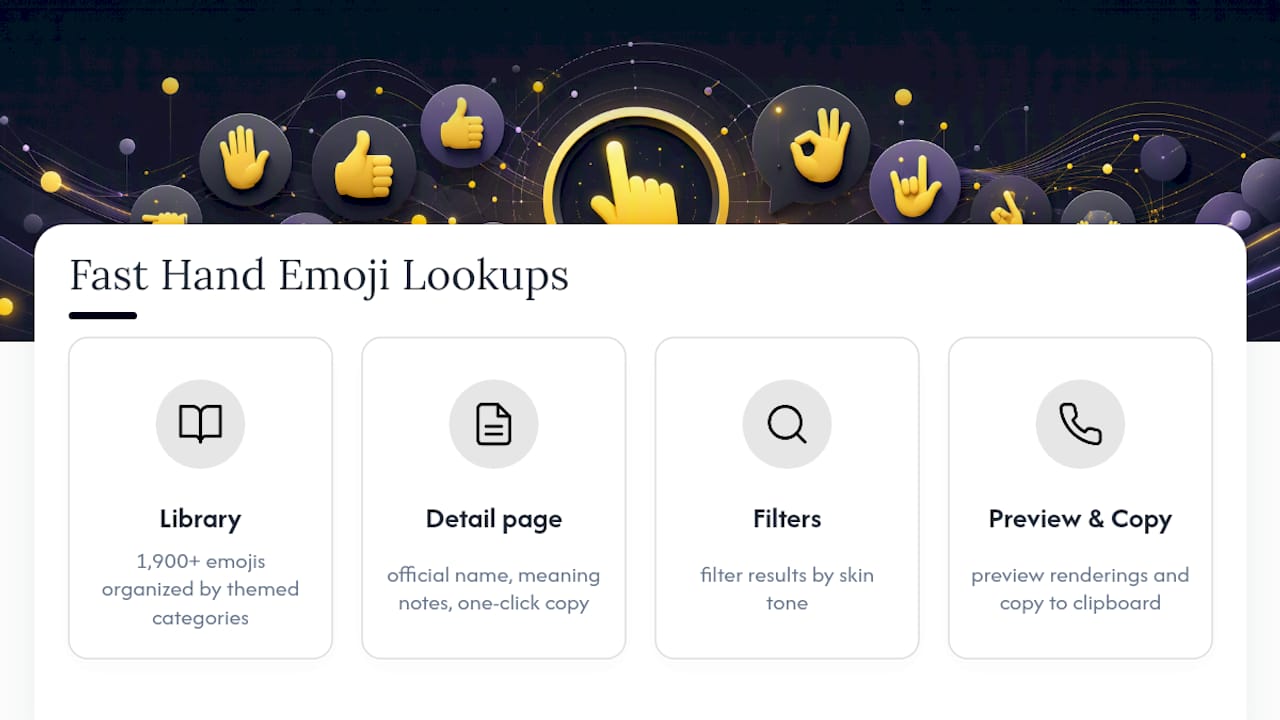
Emoji Trove runs a searchable library of more than 1,900 emojis, organized into themed, easy-to-navigate categories instead of one long, unsorted grid. Every hand gesture on this list has its own detail page with the official name, meaning notes, and a one-click copy button, similar in format to pages like the smiling face with open hands emoji. You can filter by skin tone, preview how a gesture renders, and copy it straight to your clipboard without digging through a phone keyboard.
What Actually Matters When You’re Picking a Hand Emoji
Most advice about hand emojis focuses on decoding meaning, as if every gesture has one fixed definition waiting to be looked up. That’s backwards. The ambiguity is often the point. A 🙏 can mean “thank you,” “please,” or “fingers crossed,” and the sender usually wants you to read the room rather than the dictionary entry.
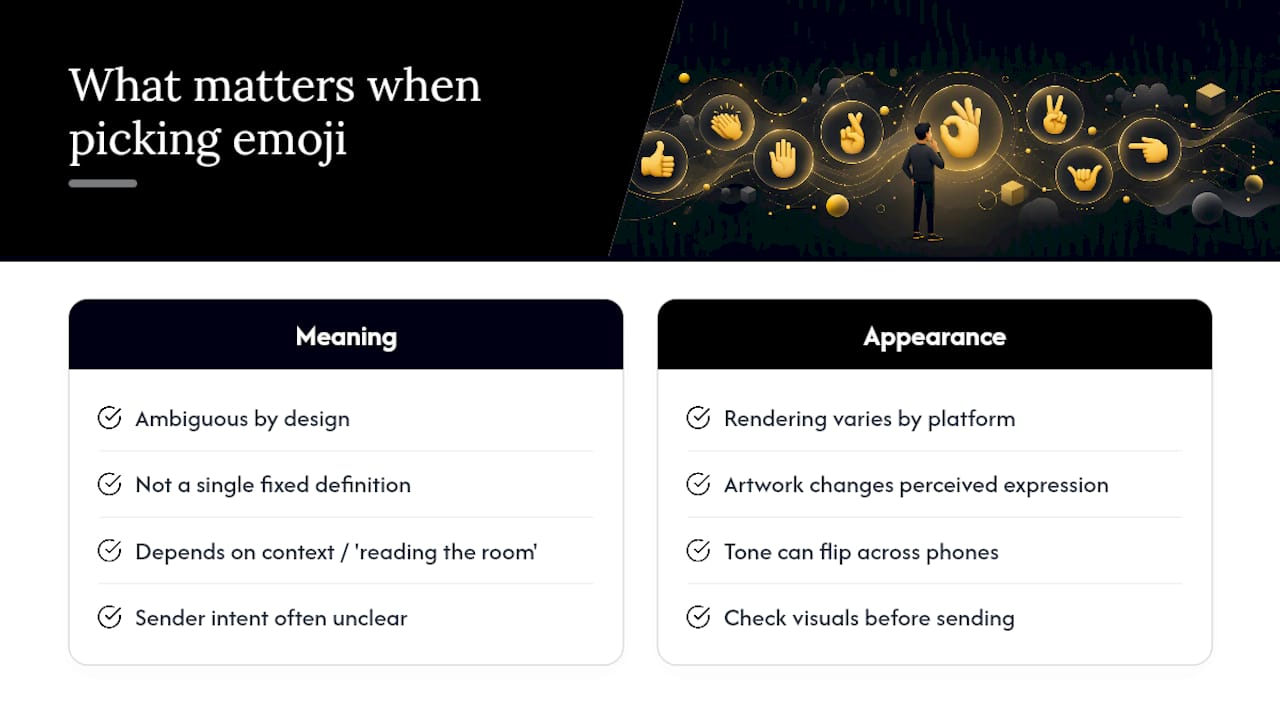
Where conventional guides fall short is treating platform rendering as an afterthought. It isn’t. Two people can send the identical Unicode code point and see visibly different artwork, which changes tone more than most senders realize. A pinched-fingers emoji that looks sharp and sarcastic on one phone can look almost cheerful on another.
If you take one thing from this list, prioritize checking how a gesture actually renders before you lean on it in anything that matters, whether that’s a work message or a first conversation with someone new. Meaning is only half the equation. Appearance is the other half, and it’s the half people skip.
— Nkosi
Copy, Preview, and Send the Right Gesture in Seconds
Picking the right hand emoji is only half the job. Seeing exactly how it renders before you hit send is what actually prevents the awkward “wait, that’s not what I meant” follow-up text. Copy and paste tools let users select a skin tone, preview the glyph, and grab it instantly, no digging through a phone’s emoji drawer required.
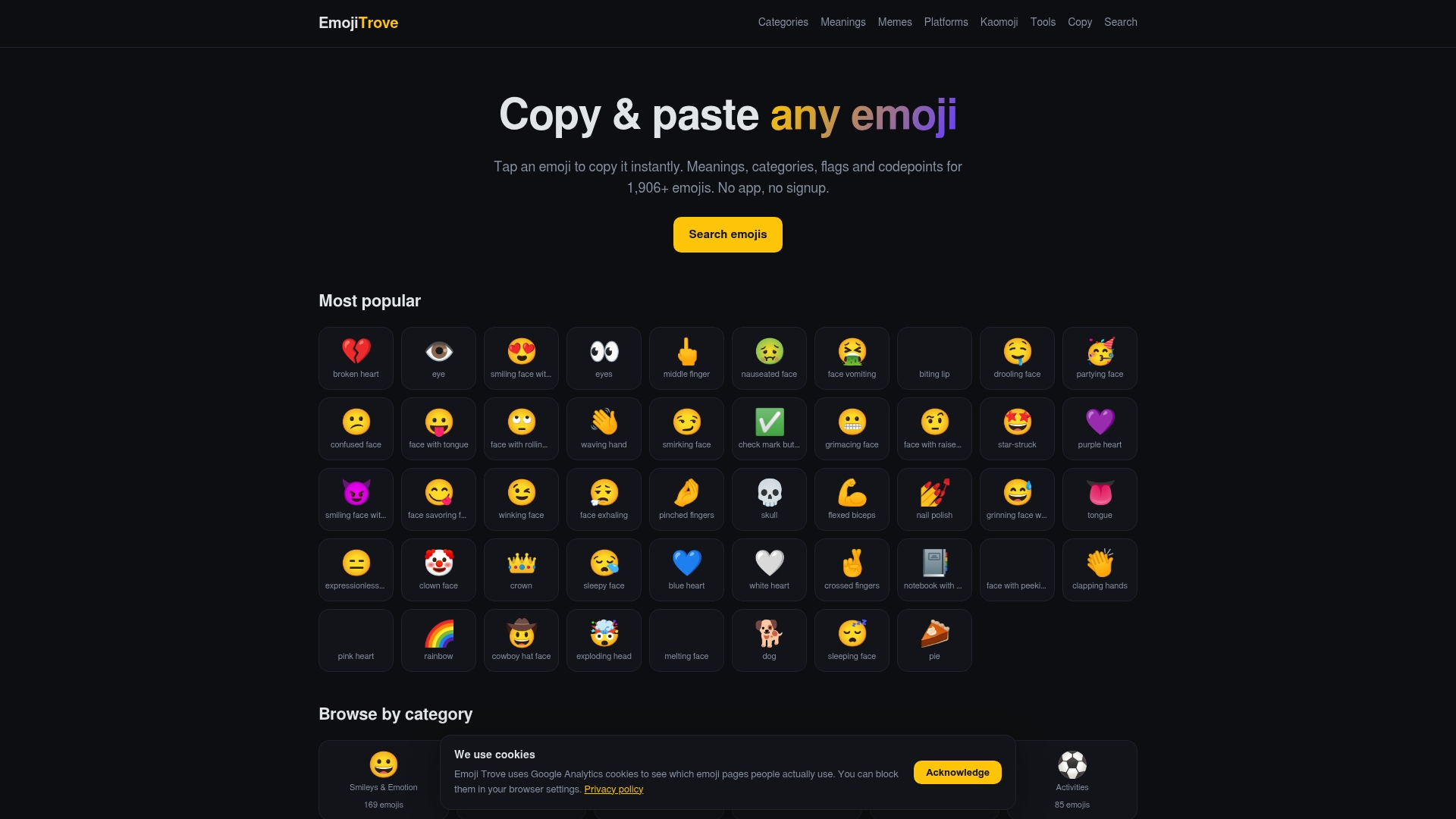
Whether you’re after a quick 🙌 for a group chat or need to double check how 🤌 looks across devices, the emoji copy and paste tool has the full hand emojis list ready to go, alongside broader emoji tools for previewing rendering across platforms. Browse the library, pick your gesture, and copy it straight into whatever you’re writing next.
Where This List Comes From
The gestures, names, and codepoints here trace back to Unicode’s official full emoji list, the canonical source every platform builds its keyboard from. Meaning and usage notes draw on WikiHow’s hand emoji guide and Quillbot’s meaning chart, both of which offer example-backed explanations worth a closer read if you want more context on any single gesture.
Sources
- Full Emoji List, v17.0
- What Do All the Different Hand Emojis Mean? (wikiHow)
- Hand Emoji Meanings | Guide & Examples (Quillbot)
- ADL — OK hand gesture (context and misuse)
FAQ
What does 🙌 🙌 🙌 mean?
Repeating the raised hands emoji several times in a row amplifies celebration or gratitude. It’s the same gesture as a single 🙌, just turned up for emphasis, not three separate meanings stacked together.
What is the difference between 🤘 and 🤟?
🤘 is the sign of the horns, tied to rock music and general excitement, made with the pinky and index finger raised. 🤟 is the love-you gesture, which adds the thumb and directly matches the American Sign Language sign for “I love you.”
What are the different types of hand emojis?
They generally fall into pointing and finger gestures, single-hand gestures like waving or a thumbs up, two-hand gestures like clapping or heart hands, fists for solidarity, and expressive gestures like nail polish or pinched fingers.
What does the 🤌 hand emoji mean?
Known as the pinched fingers or “Italian hand,” it typically signals emphasis, impatience, or “what do you mean?” The exact tone depends heavily on the surrounding message and the platform it’s viewed on.