Fire Emoji Meaning: What 🔥 Really Says in a Text

The fire emoji 🔥 most often means “this is excellent”: a great outfit, a great song, a great idea, a great performance. It can also flirt (“you look hot”), and sometimes it just means actual fire. Which one you are looking at depends on who sent it, what it is attached to and what came before it in the chat.
This guide walks through each meaning, shows how to tell them apart with real-looking examples, explains how 🔥 differs from ❤️🔥 and other flame-adjacent emojis, and gives you a simple way to use it without sending the wrong message.
TL;DR
- 🔥 usually means something is cool, awesome, exciting or “on fire” in the sense of doing extremely well.
- In a dating chat it can mean “you’re hot”; among friends and coworkers it is usually plain praise.
- It can also be literal: a campfire, a wildfire, a hot pan, spicy food or a heated moment.
- ❤️🔥 (heart on fire) is a different emoji, closer to passion or intense love than to “that’s great”.
- When in doubt, read the context: the relationship, the topic and the other emojis beside it.
Table of Contents
- What the fire emoji means
- The “lit” connection
- When 🔥 is flirty
- When 🔥 is literal
- Why the same emoji reads differently to different people
- Quick reference: what 🔥 means by situation
- Fire emoji vs. heart on fire: what’s the difference?
- Common combinations
- How to use 🔥 without sending the wrong message
- Our perspective
- Find, copy and compare emojis in one place
- FAQ
- Sources
What the fire emoji means
The core meaning is approval. Dictionary.com’s entry for the fire emoji says it commonly signals that something is cool, awesome, exciting or excellent, and that it can refer literally to flames or figuratively to attractiveness or doing something extremely well. The same entry notes people use it to praise a person, an object, an album, a movie, a performance or just about any subject as exceptionally good.
Think of it as the visual version of “that’s fire” or “you’re on fire today.” The flame stands for heat, energy and intensity, and English slang has long treated heat as a compliment: a hot take, a hot streak, a hot new release.
A few everyday examples:
- “Just got the new album 🔥🔥🔥”: this is excellent.
- “Your presentation was 🔥”: you did really well.
- “That shirt looks 🔥 on you”: you look great.
- “Leaving for the lake, campfire tonight 🔥”: a literal fire.
Repeating the emoji turns up the volume. One 🔥 is a nod; three or five is a shout. A single flame after a plain sentence often reads as warm and casual, while a long row can feel excited or, depending on the sender, a little over the top.
The “lit” connection
Much of the emoji’s slang meaning comes from the word “lit.” According to Dictionary.com’s slang entry for “it’s lit”, when 🔥 is paired with that phrase it emphasizes something’s metaphorical hotness, and “it’s lit” itself means something is really good, intense, fun or exciting.
So a party, a concert or a game can be “lit,” and the flame is the picture that goes with it. You will often see the two together: “Saturday’s going to be lit 🔥.” Even without the word, the emoji carries the same energy.
When 🔥 is flirty
The same flame can carry a romantic charge. In a dating or flirting context, the flame emoji can mean the sender thinks you’re hot, as Metro’s explainer on the flame emoji puts it. The same article points out that in a nonsexual setting, friends, colleagues or family members may use it simply to show they are impressed by an outfit, a meal, a film, a book or an opinion.
A Spanish newspaper’s guide to key emojis, published by EL PAÍS in 2023, gives a handy example of the compliment reading: “That shirt looks 🔥 on you.” It also lists looking hot and passion as meanings of the flame.
Signs the flame is flirting
No single clue settles it, but these add up:
- The relationship. A match you have been chatting with for a week is not your aunt or your manager.
- The subject. A flame under a selfie reads differently from a flame under a spreadsheet.
- The company it keeps. Pairings with 😍, 😉 or 😏 push it toward attraction. Alone, it is usually just approval.
- The conversation so far. If the thread already has a flirty tone, the flame probably continues it.
- Timing and privacy. A flame in a one-to-one late-night message is not the same as one in a group chat.
Metro’s discussion treats the sender-recipient relationship, the surrounding conversation and the subject of the post as the main clues that separate flirtation from ordinary praise. That matches how most people read it in practice.
When 🔥 is literal
Sometimes the flame is just fire. People use it for a campfire, a barbecue grill, a candle-lit evening, a stove, a bushfire or a wildfire. It also stretches to physical and figurative heat: a hot day, spicy food, an intense workout, or pressure (“feeling the heat” before a deadline).

Literal use is easiest to spot because the surrounding words name the thing. “Smoke everywhere, stay safe 🔥” is not a compliment. If a news-style post about a real emergency has a flame in it, read it as a warning or a description, not as praise. Be careful in those moments: using “that’s fire” energy on a disaster post can land badly, so keep the flame for good things when real harm is involved.
If you want a more precise symbol for the real-life side, our firefighter emoji page covers the people who deal with actual fires, which is a useful contrast when you want to talk about a real incident rather than hype.
Why the same emoji reads differently to different people
Emoji are not a fixed dictionary. In the EL PAÍS guide, linguist Vela describes emojis as polysemous (one symbol, many meanings) and says their meanings change substantially by age group and speech community. A teenager, a marketing manager and a grandparent can each use 🔥 sincerely and mean different things.
The Guardian’s 2017 piece on using emoji correctly reaches the same conclusion from another angle. It describes “fire” as commonly meaning someone or something is hot or exemplary, while stressing that emoji are not consistent and stay open to interpretation. The takeaway: the emoji does not decide the meaning, the context does.

There is also a platform factor. The flame looks a little different on iPhone, Android, Windows and in apps like WhatsApp, and the art style can change how bold or playful it feels. If you want to see how emoji behave in that app in particular, our guide to what WhatsApp emojis actually mean is a good next stop.
Quick reference: what 🔥 means by situation
| Situation | Likely meaning | Example |
|---|---|---|
| Reacting to a post, song or video | This is great | “New single 🔥” |
| Praising someone’s work | You did very well | “That pitch was 🔥” |
| Complimenting looks among friends | You look great | “Haircut 🔥” |
| Dating chat, with 😍 or 😏 | Attraction | “Okay that photo 🔥😏” |
| Streaks and goals | On a hot run | “7 days in a row 🔥” |
| Weather, food, cooking | Literal heat | “Tacos with extra hot sauce 🔥” |
| News or emergency posts | Real fire | “Brush fire near the highway 🔥” |
Fire emoji vs. heart on fire: what’s the difference?
The two are easy to mix up, but they do different jobs.
🔥 (fire) is a general-purpose “wow.” It can describe anything: a song, a sneaker, a meal, a person. It is quick, casual and aimed at things as much as people.
❤️🔥 (heart on fire) is a combined emoji built from a red heart and the flame. Because the heart is in the middle of it, it points at feelings: intense love, passion, desire, or a burning commitment to something. People also use it for determination, such as a deep passion for a craft or cause. You would say 🔥 about a concert and ❤️🔥 about someone you are head over heels for.
A practical rule:
- Saying something is great: use 🔥.
- Saying you feel strongly: use ❤️🔥.
- Saying something is dangerous or urgent: neither, spell it out.
Because ❤️🔥 is a newer sequence, older phones or apps may show it as a separate heart and flame side by side instead of one combined symbol. If the person you are texting has an older device, a plain 🔥 or ❤️ is safer. When you are unsure how a recently added emoji will display, check which release introduced it; our Emoji 16.0 page shows how a version list is laid out, so you can see what newer sets include.
Other flame-adjacent emojis
- 🧯 Fire extinguisher: literal safety, or a joke about putting out drama.
- 🚒 Fire engine: emergencies, or “call the fire department” when a situation is a mess.
- 🎆 Fireworks: celebration, excitement and big finishes. See our fireworks emoji page for how it differs from the flame.
- 🧊 Ice: the opposite temperature, used for “cool” in the literal sense or for a cold shoulder. Our ice emoji page explains it, and 🔥🧊 together often signals contrast or a push-and-pull.
- 🚩 Red flag: a warning in dating, the flip side of flirty flames. Read our guide to the red flag emoji in texting and dating.
Common combinations
Emoji gain nuance in pairs. Here is how 🔥 shifts depending on what sits beside it.
- 🔥💯: top-tier, no doubt about it. Used for performance and quality.
- 🔥🔥🔥: heavy emphasis. Hype, excitement, a big reaction.
- 🔥😍: you look amazing, or I love this.
- 🔥😏: playful flirting.
- 🔥🙌: celebration of someone’s win.
- 🔥👏: applause for a job well done.
- 🔥💀: so good it is funny, or so intense I am done. Meaning varies by community.
- 🔥🧊: hot and cold, a contrast.
- 🔥🚫: stop the drama, or no heat wanted.
Emoji like these shift quickly. If a pairing is new to you, search it before you send it.
How to use 🔥 without sending the wrong message
- Match the relationship. With close friends, use it freely. With colleagues, stick to work-appropriate praise: a result, a launch, a good presentation.
- Name the thing. “Great deck 🔥” is clear. A bare 🔥 under someone’s photo can be read two ways.
- Check your other emojis. Hearts, winks and eyes beside a flame push it romantic.
- Watch the topic. Do not use it on posts about real disasters, injuries or losses.
- Keep it proportionate. One or two flames feel natural. Ten look like a spam reaction.
- Ask when it matters. If you are unsure whether a message was flirty, a quick “haha thanks, what did you mean?” beats guessing.
For brands and creators, the flame works well for product drops, limited offers, trending content and streaks. Keep it to a signal of enthusiasm and let your words carry the facts. Overuse dilutes it, and audiences of different ages may read it differently, as the linguist’s point above suggests.
If you ever see a flame in a message and cannot tell whether someone means it as a compliment or as an advance, the conversation history is the best tiebreaker. A flame on the first message from a stranger deserves more caution than a flame from a friend who has said “you killed it” in three previous messages.
Our perspective
We see the fire emoji as the most useful example of why emoji meanings need context rather than a one-line definition. When we build an emoji page, we try to show the dictionary meaning first, then the situations that bend it: who is sending, what they are talking about and what else is in the message. 🔥 shows this in miniature. It means “great” for most people most of the time, yet a single companion emoji can turn it into flirting, and a single noun can turn it back into a campfire.
Our advice is to treat any emoji as a hint, not a verdict. Read the room, look at the whole message and, if you are the sender, make your intent obvious with a few plain words. The flame is a wonderful shortcut when everyone shares the same reading and a poor one when they do not. That is also why we pair every emoji with its meanings, uses and platform appearance: so you can check before you send.
— Nkosi
Find, copy and compare emojis in one place
If you want to copy 🔥 or look at its neighbors without scrolling through endless grids, the Emoji Trove library lets you search by name or browse by theme, then copy with one click. It covers more than 1,900 emojis, with meanings, uses and Unicode details for each, plus kaomoji and themed sets.
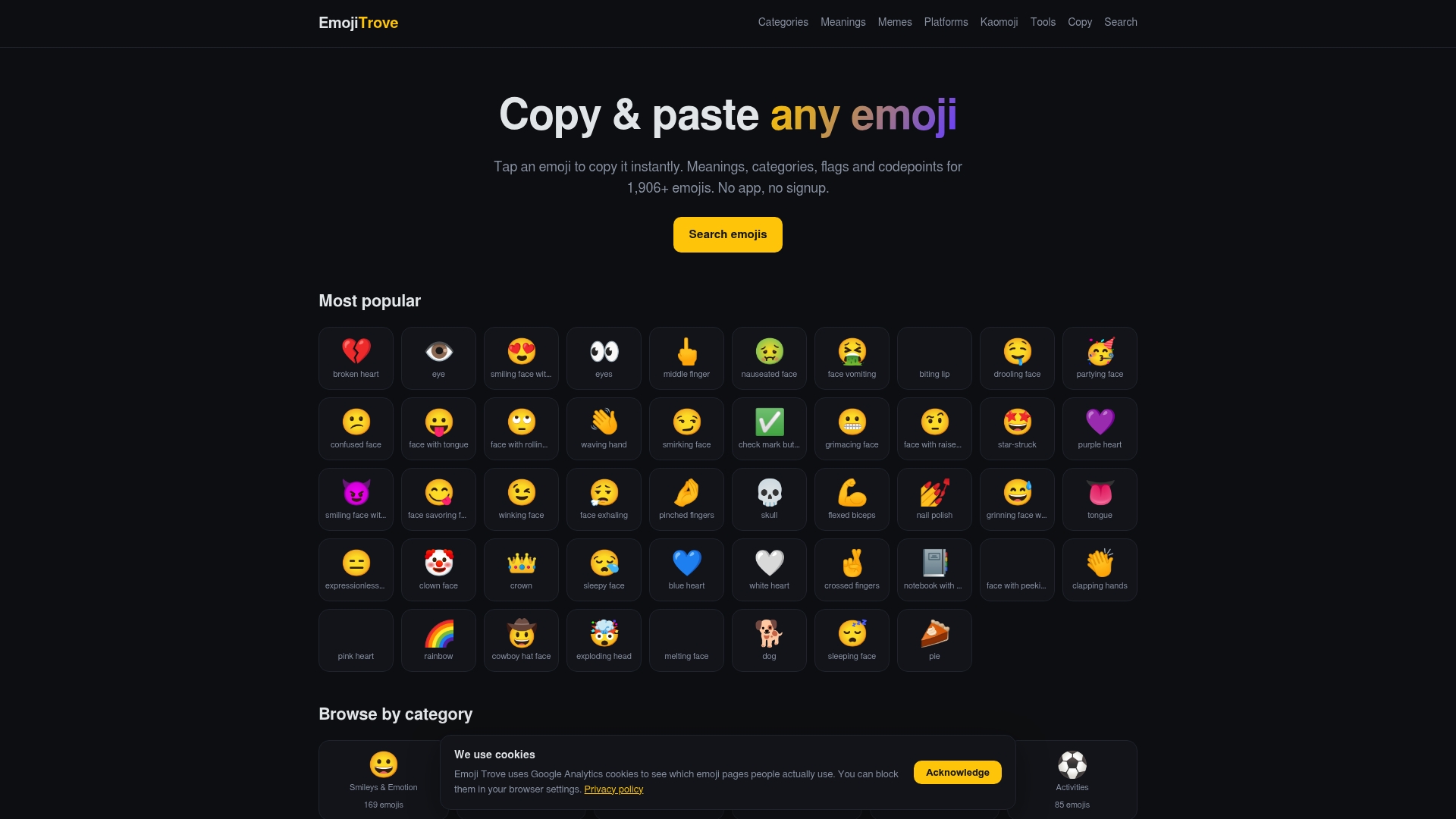
Head to the Emoji Trove home page to search for “fire,” “heart on fire” or any other symbol, and read how each one is used before you send it. You can also look at related emojis such as the eye emoji, which often shows up beside a flame in reactions like 👀🔥.
FAQ
What does the fire emoji mean in a text?
Most of the time it means something is excellent, exciting or impressive, as in “that song is 🔥.” Between people who are flirting, it can mean “you look hot.” It can also be literal, such as a campfire or a real fire in the news.
Is the fire emoji flirty?
It can be, but it is not always. In a dating context it can show attraction, while friends, colleagues and family often use it to say they are impressed by an outfit, a meal or an idea. Look at the relationship, the subject and any emojis beside it, such as 😍 or 😏.
What does the flame emoji mean compared with “lit”?
They express the same idea. “Lit” is slang for something really good, intense, fun or exciting, and the flame is the picture people attach to it. “Tonight is lit 🔥” simply doubles the message.
What is the difference between 🔥 and ❤️🔥?
The plain flame is general praise for people, things and events. The heart on fire combines a heart with the flame and leans toward intense love, passion or devotion. Use the first to say something is great and the second to say you feel strongly.
Can I use the fire emoji at work?
Yes, when it praises a result or a launch and your team’s culture is casual. Keep it to one or two flames, attach it to a clear subject, and avoid it on anything involving real fires, accidents or bad news.
Sources
- 🔥 Fire emoji | Emoji | Dictionary.com
- it’s lit | Slang | Dictionary.com
- What does the flame emoji mean? Different uses explained | Metro
- A guide for understanding 25 key emojis | EL PAÍS English
- Am I using this emoji right, or did I accidentally just sext someone? | The Guardian